Worked solution
Recognise the same rational inequality after a substitution
Without using a calculator, solve .
Hence solve .
CJC · Lecture · Example 10
Complete the square and remove a known positive numerator
for every real x. Thus the first inequality is equivalent to . Mark poles −3,2; signs are +,−,+. Hence −3<x<2.
How did this part go?
Match every occurrence in the second expression
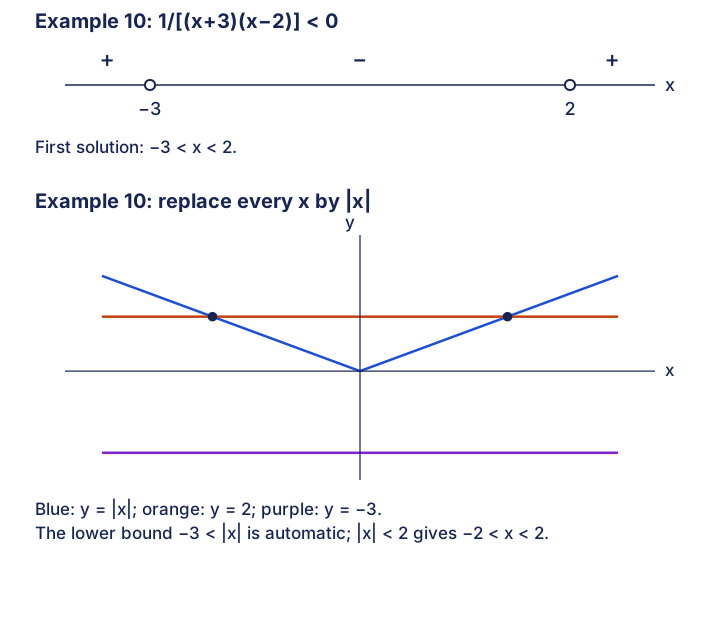
The repeated blank in the source prompt is filled by |x|: its square is |x|²=x², its linear term is 2|x| and both denominator factors use|x|. Replace the old variable by u=|x| to obtain −3<|x|<2.
How did this part go?
Apply the range of the substituted expression
Since |x|≥0, the lower bound −3<|x| always holds. The graph of y=|x| with levels −3 and 2 leaves |x|<2, so −2<x<2. The inputs ±2 are poles in the substituted expression and are excluded.
How did this part go?
Compare your sketch
Expand diagramFit diagram to page
Use the scrollbars or arrow keys to inspect details.
Common mistakes
A valid hence substitution must replace every occurrence, including squared terms. Use |x|²=x² and then apply |x|≥0.