Porisma

Worked solution

Carry out each specified substitution

Find (a) ∫x(2−3x)11 dx\int x(2-3x)^{11}\,dx, using u=2−3xu=2-3x; (b) ∫x+1xx−2 dx\int\frac{x+1}{x\sqrt{x-2}}\,dx, using u=x−2u=\sqrt{x-2}; (c) ∫1(x2+4)3/2 dx\int\frac1{(x^2+4)^{3/2}}\,dx, using x=2tan⁡θx=2\tan\theta, −π/2<θ<π/2-\pi/2<\theta<\pi/2; (d) ∫9−x2x2 dx\int\frac{\sqrt{9-x^2}}{x^2}\,dx, using x=3sin⁡θx=3\sin\theta, −π/2≤θ≤π/2-\pi/2\le\theta\le\pi/2.

CJC · Lecture · Example 16

(a) Change variable and differential

u=2−3xu=2-3x gives du/dx=−3du/dx=-3, dx/du=−1/3dx/du=-1/3 and x=(2−u)/3x=(2-u)/3. Therefore the integral becomes ∫2−u3u11(−13) du=−19∫(2u11−u12) du\int\frac{2-u}{3}u^{11}(-\frac13)\,du=-\frac19\int(2u^{11}-u^{12})\,du.

How did this part go?

(a) Integrate and return to x

The result is −19(2u1212−u1313)+C=−u1254+u13117+C=−(2−3x)1254+(2−3x)13117+C-\frac19(\frac{2u^{12}}{12}-\frac{u^{13}}{13})+C=-\frac{u^{12}}{54}+\frac{u^{13}}{117}+C=-\frac{(2-3x)^{12}}{54}+\frac{(2-3x)^{13}}{117}+C. These are the source four steps: differentiate the substitution, replace every x and dx, integrate in u, then return to x.

How did this part go?

(b) Transform using implicit differentiation

For x>2x>2, u2=x−2u^2=x-2 gives 2u du/dx=12u\,du/dx=1, dx/du=2udx/du=2u and x=u2+2x=u^2+2. Hence ∫x+1xx−2 dx=∫u2+3(u2+2)u(2u) du=2∫u2+3u2+2 du\int\frac{x+1}{x\sqrt{x-2}}\,dx=\int\frac{u^2+3}{(u^2+2)u}(2u)\,du=2\int\frac{u^2+3}{u^2+2}\,du.

How did this part go?

(b) Divide and integrate

The source asks how to handle the improper rational function; the Teacher supplies long division. Since (u2+3)/(u2+2)=1+1/(u2+2)(u^2+3)/(u^2+2)=1+1/(u^2+2), the result is 2[u+12tan⁡−1(u/2)]+C=2x−2+2tan⁡−1(x−2/2)+C2[u+\frac1{\sqrt2}\tan^{-1}(u/\sqrt2)]+C=2\sqrt{x-2}+\sqrt2\tan^{-1}(\sqrt{x-2}/\sqrt2)+C.

How did this part go?

(c) Simplify on the stated angle interval

x=2tan⁡θx=2\tan\theta gives dx=2sec⁡2θ dθdx=2\sec^2\theta\,d\theta. Since cos⁡θ>0\cos\theta>0 on the stated interval, (4tan⁡2θ+4)3/2=43/2(sec⁡2θ)3/2=8sec⁡3θ(4\tan^2\theta+4)^{3/2}=4^{3/2}(\sec^2\theta)^{3/2}=8\sec^3\theta. The integral is ∫2sec⁡2θ8sec⁡3θ dθ=14∫cos⁡θ dθ=14sin⁡θ+C\int\frac{2\sec^2\theta}{8\sec^3\theta}\,d\theta=\frac14\int\cos\theta\,d\theta=\frac14\sin\theta+C.

How did this part go?

(c) Recover the trigonometric ratio

The Teacher triangle for x>0x>0 has opposite side x, adjacent side 2 and hypotenuse x2+4\sqrt{x^2+4}. Thus sin⁡θ=x/x2+4\sin\theta=x/\sqrt{x^2+4} and the result is x/[4x2+4]+Cx/[4\sqrt{x^2+4}]+C. Signed principal-angle identities give the same formula for every real x. The source recommends a quick right-triangle sketch instead of leaving sin⁡(tan⁡−1(x/2))\sin(\tan^{-1}(x/2)) unevaluated.

How did this part go?

(d) Use the nonnegative cosine branch

dx=3cos⁡θ dθdx=3\cos\theta\,d\theta and 9−x2=3∣cos⁡θ∣=3cos⁡θ\sqrt{9-x^2}=3|\cos\theta|=3\cos\theta on the stated interval. On −π/2<θ<π/2-\pi/2<\theta<\pi/2, θ≠0\theta\ne0, the transformed integral is ∫3cos⁡θ9sin⁡2θ(3cos⁡θ) dθ=∫cot⁡2θ dθ=∫(csc⁡2θ−1) dθ=−cot⁡θ−θ+C\int\frac{3\cos\theta}{9\sin^2\theta}(3\cos\theta)\,d\theta=\int\cot^2\theta\,d\theta=\int(\csc^2\theta-1)\,d\theta=-\cot\theta-\theta+C.

How did this part go?

(d) Return to x and retain the pole

The source triangle for x>0x>0 has hypotenuse 3, opposite side x and adjacent side 9−x2\sqrt{9-x^2}. Therefore the antiderivative is −9−x2/x−sin⁡−1(x/3)+C-\sqrt{9-x^2}/x-\sin^{-1}(x/3)+C, initially on each interval −3<x<0-3<x<0 and 0<x<30<x<3. Signed ratios extend the working to negative x. The printed closed angle range includes endpoints; endpoint values can be taken by one-sided limits, while the substitution calculation uses open intervals and x=0 remains excluded.

How did this part go?

Compare your sketch

Expand diagram

Use the scrollbars or arrow keys to inspect details.
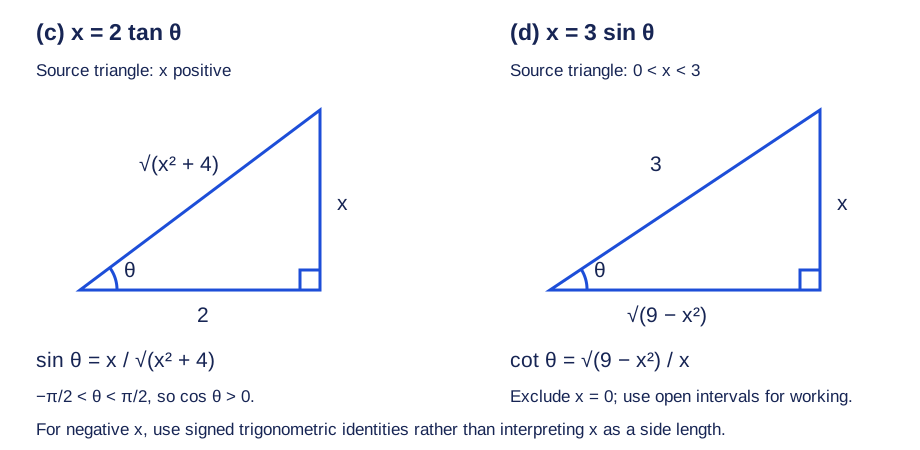
Two source right-triangle reconstructions for x positive. For x=2 tan theta, opposite x, adjacent 2, hypotenuse square root of x squared plus 4; sine theta equals x over that hypotenuse. For x=3 sin theta, hypotenuse 3, opposite x, adjacent square root of 9 minus x squared; cotangent theta equals that adjacent side over x. Signed principal-angle identities cover negative x; a negative x is not a negative geometric side length.

Common mistakes

A positive-quadrant triangle illustrates ratios for x>0. Negative x needs signed identities, and square-root signs depend on the specified angle interval.

Read the hint