Worked solution
Substitution, elimination and a graphical check
Solve the following systems of linear equations without using a graphing calculator. (a) , . (b) , , .
CJC · Lecture · Example 1
(a) Substitution
Label as (1) and as (2). From (1), . Substitute into (2): , so and . Then . Exact fractions are , .
(a) Elimination and graphical meaning
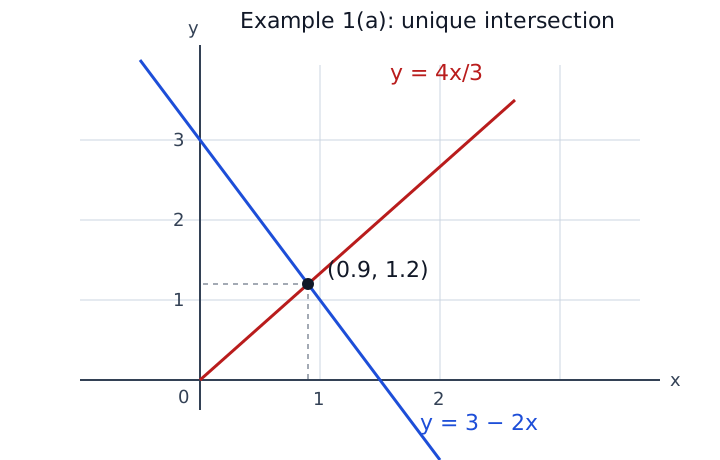
Multiply (1) by 3 to obtain . Add (2): , hence and, from (1), . Check and . The source also plots and : the unique intersection is the simultaneous solution. The diagram below redraws the mathematical content of its entry and intersection screens.
(b) Substitution
Label , , as (1), (2), (3). From (1), . Substitution into (2) gives , hence . Substitution into (3) gives , hence . Therefore and (1) gives .
(b) Elimination and verification
Subtract (1) from (2): . Substitute into (1) and (3): and . Subtract these equations: , then . Verify all three originals: , , . Thus .
Compare your sketch
Expand diagramFit diagram to page
Use the scrollbars or arrow keys to inspect details.
Common mistakes
Operate on both sides of the whole equation. A solution must satisfy every original equation; finding a point on just one line is insufficient.
Solution notes
Student and Teacher copies compared: PDF pp.3–4, printed pp.163–164. Example 1(b) ends on page 4; the following calculator workflow is retained separately as Example 2.
No marks are printed. Both methods and the two-variable graphical interpretation are retained. This incoming lecture identity is separate from the existing bank and review identities.