Worked solution
Transform the interval along with the series argument
Determine the range of x for which the power series expansion of in Example 1 is valid.
CJC · Lecture · Example 2
Apply the original interval to the new argument
The standard logarithm series represents for . With , the required condition is . The lower inequality holds automatically because .
Solve the remaining quadratic inequality
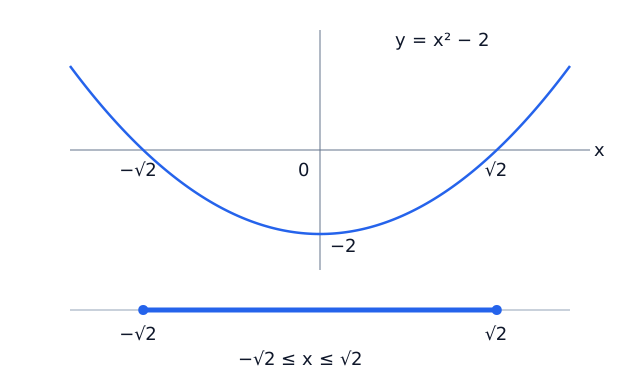
gives , or . The Teacher’s small upward-parabola sketch shows the nonpositive part between its two roots. Therefore .
Retain both endpoints and distinguish the function domain
At either endpoint , the substituted argument is 1, which is included in the original logarithm-series interval. Both endpoints therefore remain included. Independently, the function exists for every real x, but its Maclaurin representation here is limited to this closed interval; that distinction does not restrict the underlying function.
Compare your sketch
Expand diagramFit diagram to page
Use the scrollbars or arrow keys to inspect details.
Common mistakes
A function’s real domain can be larger than the interval where this Maclaurin series represents it.
Solution notes
Student/Teacher originals visually compared. Complete Teacher working retained; independent finite-truncation/domain qualifications distinguished. No marks or attribution printed.