Worked solution
Translate intervals and tails into normal probabilities
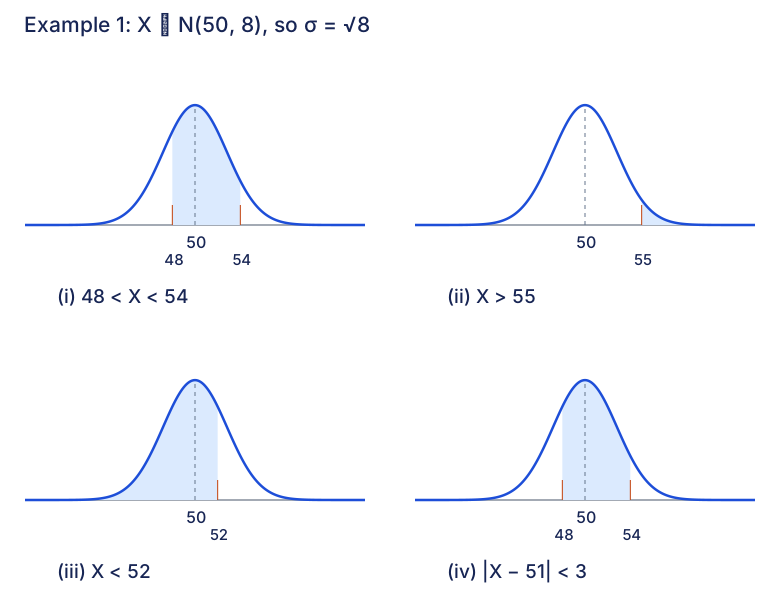
Given , find
(i) ,
(ii) ,
(iii) and
(iv) .
CJC · Lecture · Example 1
(i) Between 48 and 54
The mean is 50 and variance 8, so enter .
- Press MODE and ensure STAT WIZARDS ON for guided entry.
- Press 2 nd VARS, select 2:normalcdf, then ENTER.
- Enter lower 48, upper 54, μ50 and ; highlight Paste, then ENTER.
- Press ENTER to calculate
normalcdf(48,54,50,√8).
The displayed probability is 0.6816003607, giving 0.682 (3 s.f.). This is the area between 48 and 54, not the density at either endpoint.
(ii) Greater than 55
Shade the right tail from 55. Use lower 55, upper , μ50 and :
The large upper bound simulates the infinite tail for this calculation. Recall the Teacher’s asymptote guidance: the density approaches without terminating at a finite x.
(iii) Less than 52
Shade everything left of 52. Use lower , upper 52, μ50 and :
The lower bound simulates negative infinity. The source’s “graph below” remark refers to the left-tail graph actually printed above the input table.
(iv) A modulus event
Simplify before using the calculator:
This is exactly the interval in(i). Its centre is 51, while the distribution mean is 50; do not replace it by a symmetric interval about 50.
Compare your sketch
Expand diagramFit diagram to page
Use the scrollbars or arrow keys to inspect details.
Common mistakes
Use σ=√8, not 8. Match the shaded side to the calculator limits. A modulus event is centred at the number inside the modulus, which need not be the mean. Large finite tail bounds are numerical substitutes for infinity in this example.