Worked solution
Find the range of distinction cutoffs
The marks of a large number of examination candidates are normally distributed with mean 45 and standard deviation 10. A candidate obtains a distinction by scoring x marks or more. If less than 5% obtain a distinction, find the range of x, correct to 1 decimal place.
CJC · Lecture · Example 4
Define the marks model and boundary
Let M denote the marks of a randomly chosen candidate. The Teacher completes the model and the required inequality .
First solve the equality at a boundary k:
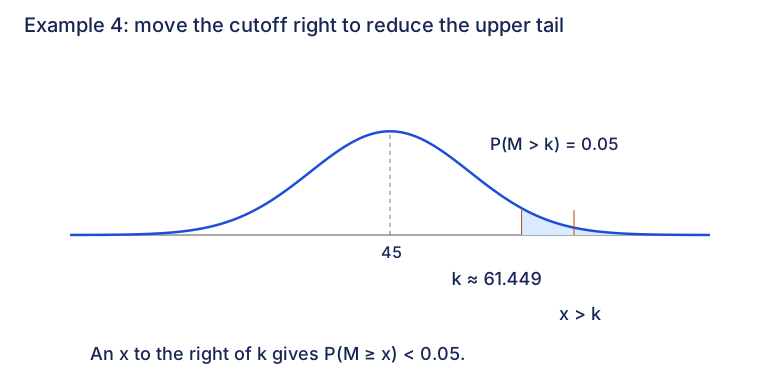
The source reports this boundary as 61.449. A left-area-only command uses 0.95 instead. Continuity means that ≥ and > give the same probability at a fixed bound.
Compare x with the boundary
The Teacher asks us to indicate the position of x on the diagram. Move x right of k: less area remains to its right, so the upper-tail probability falls below 0.05.
Therefore the full real-valued range is
If distinction cutoffs are specified to one decimal place, the smallest allowable cutoff is 61.5, so those allowable cutoffs satisfy . This explains the source’s “61.5 or more” statement. The original probability inequality remains strict; merely rounding the boundary to 61.4 would give a tail above 5%.
Compare your sketch
Expand diagramFit diagram to page
Use the scrollbars or arrow keys to inspect details.
Common mistakes
Solve the boundary equality first, then use the direction in which the shaded area changes. Distinguish the real range x>61.4485… from the allowed one-decimal cutoffs x≥61.5; do not replace the probability inequality by an equality.