Worked solution
Decide whether an interval is central
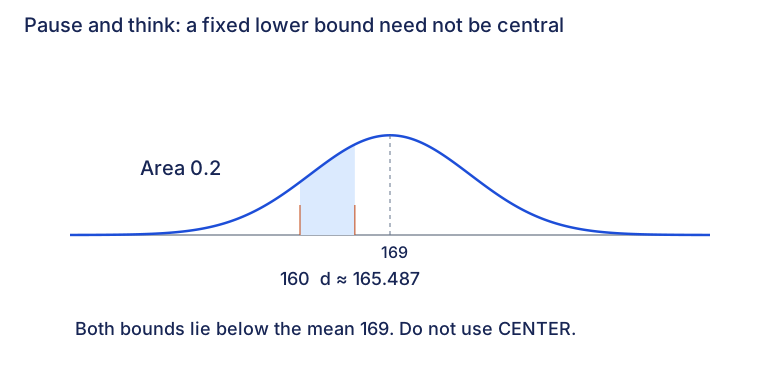
The heights of male CJCians are normally distributed with mean 169 cm and standard deviation 8 cm. Given that 20% have a height between 160 cm and cm, with , find d. Can we use invNorm(p,μ,σ,CENTER)?
CJC · Lecture · Pause and think
Add the interval area to the lower cumulative area
Let . The lower bound 160 is fixed. First find
Because and ,
Use normalcdf(−10^99,160,169,8) to obtain the first area, keep that full result and add 0.2. Then use invNorm(0.3302945171,169,8,LEFT) to obtain cm, or (3 s.f.). The decimal 165.487 cm is included to show the interval’s position; the source does not prescribe a rounding instruction for this prompt.
Explain why CENTER is unsuitable
No. A central interval with lower bound 160 and mean 169 would have upper bound 178 by symmetry. That interval’s area is not 0.2. In the required solution, both 160 and d≈165.487 lie below the mean 169, so the interval is asymmetric.
Use the sketch to check the given area, rather than assuming that any interval probability is central. The source prints “169 am”; this is a unit typo, interpreted as 169 cm in its height context. The printed prompt has no worked answer; the cumulative-area solution here is authored to complete the question.
Compare your sketch
Expand diagramFit diagram to page
Use the scrollbars or arrow keys to inspect details.
Common mistakes
An interval with a specified lower endpoint is not automatically centred on the mean. CENTER would impose equal tail areas that this question does not give. Retain the lower cumulative probability before adding 0.2.