Worked solution
Sketch a scaled rational curve and verify its asymptote
For , , , where , find the y-axis intersection and any asymptotes. Sketch the curve.
CJC · Lecture · Example 3
Find the intercept and limiting height
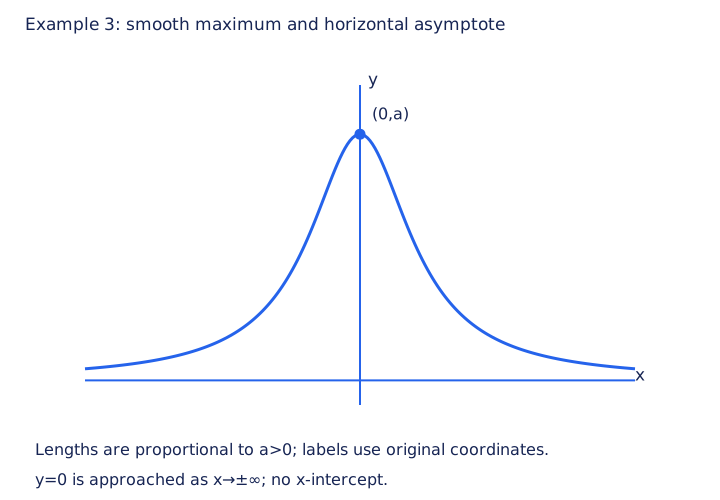
At , and give , so the intercept is . As , also , and . Thus is the horizontal asymptote. The denominator is positive for all real t, so there is no finite vertical asymptote.
How did this part go?
Describe the complete sketch
Eliminating t gives . It is positive and symmetric about the y-axis, with a smooth maximum at and both tails approaching but never reaching the x-axis. The source peak is drawn sharply schematically; the actual rational curve is smooth.
How did this part go?
Compare your sketch
Expand diagramFit diagram to page
Use the scrollbars or arrow keys to inspect details.
Common mistakes
The horizontal asymptote is not an x-axis intersection.