Worked solution
Retain the positive branch when eliminating a radical parameter
For and , find a Cartesian equation and sketch the curve.
CJC · Lecture · Example 4
Isolate t using y
gives , hence . Therefore .
How did this part go?
Restore the restrictions from the original equations
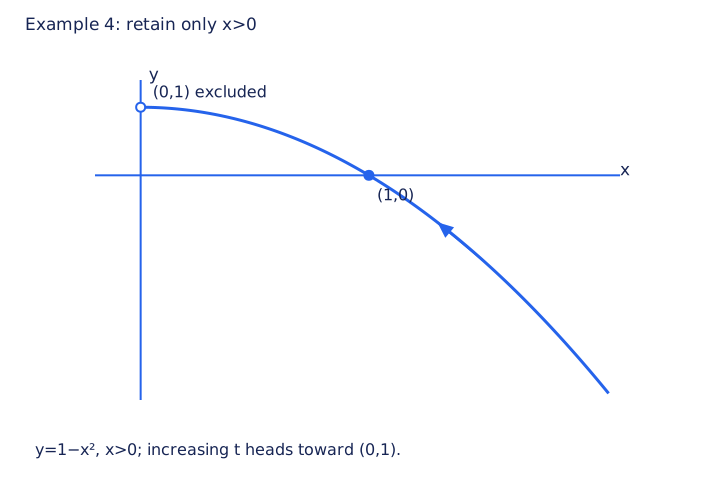
The real reciprocal square root requires , and x is strictly positive. Thus , . This is only the right half of the downward parabola: it approaches the excluded point as and crosses the x-axis at when . As , x tends to infinity and y to minus infinity.
How did this part go?
Compare your sketch
Expand diagramFit diagram to page
Use the scrollbars or arrow keys to inspect details.
Common mistakes
The Cartesian polynomial alone would add the forbidden left branch and the endpoint x=0.