Worked solution
Count restricted committees using cases and complements
A class consists of 8 girls and 10 boys. How many committees of 4 can be formed if
(i) there are no restrictions,
(ii) the committee has at most 1 boy,
(iii) the committee must have at least 1 girl,
(iv) Boy A or Girl B must be in the committee?
CJC · Lecture · Example 8
(i) Choose any four of the eighteen people
There are 18 people altogether, so the number is .
(ii) Split at most one boy into two disjoint cases
With no boys, choose 4 girls: . With one boy, choose 1 of 10 boys and 3 of 8 girls: . Add the disjoint cases:70+560=630. Multiplication counts the choices within the one-boy case; addition joins the alternatives. Reversing the selection stages gives , the same count. Changing the order of these counting stages does not assign roles to committee members.
(iii) Method 1: count one, two, three or four girls
The four disjoint cases are:
| Girls | Boys | Number of committees |
|---|---|---|
| 1 | 3 | |
| 2 | 2 | |
| 3 | 1 | |
| 4 | 0 |
Add:960+1260+560+70=2850.
(iii) Method 2: subtract the no-girl complement
Choose any 4 people, then subtract all-boy committees: . The source recommends no restriction minus complement cases when the direct approach creates too many cases.
(iv) Method 1: subtract the double-counted overlap
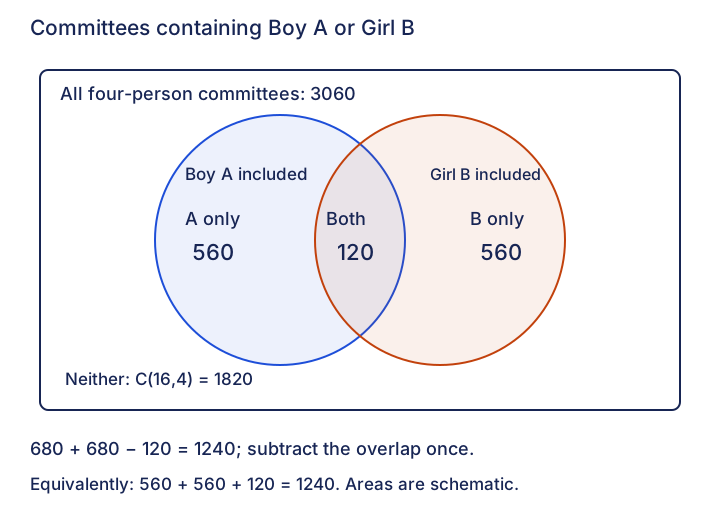
Here or is inclusive: both A and B may serve. Committees containing A number ; those containing B also number 680. Those containing both number . Therefore the required number is . The Venn diagram follows the Teacher note: subtract the intersection once because the first two counts include it twice.
(iv) Method 2: use three disjoint membership cases
A is included and B excluded: . B is included and A excluded: . Both are included: . Thus 560+560+120=1240. In the second case, both source copies print Boy B; this is a name slip for Boy A, since the distinguished people are Boy A and Girl B.
Compare your sketch
Expand diagramFit diagram to page
Use the scrollbars or arrow keys to inspect details.
Common mistakes
At most one includes zero. At least one can be counted by subtracting none. Inclusive or includes both, so adding the two membership counts alone double-counts their overlap.
Solution notes
Teacher-only Venn instruction integrated as an answer diagram and overlap explanation. All four asks, direct/complement methods, every numerical case and reversed-stage remark retained. Source BoyBname slip explicitly qualified.