Worked solution
Partition children into unlabelled groups
In how many ways can a party of 10 children be divided into
(i) one group of 2 and one group of 8,
(ii) two groups of 5,
(iii) three groups of sizes 2,4 and 4?
CJC · Lecture · Example 10
(i) Groups of different sizes identify themselves
Choose the 2-person group, then all 8 remaining children form the other group: . The different group sizes prevent a stage swap from creating a second representation of this same selection process; do not divide by 2!.
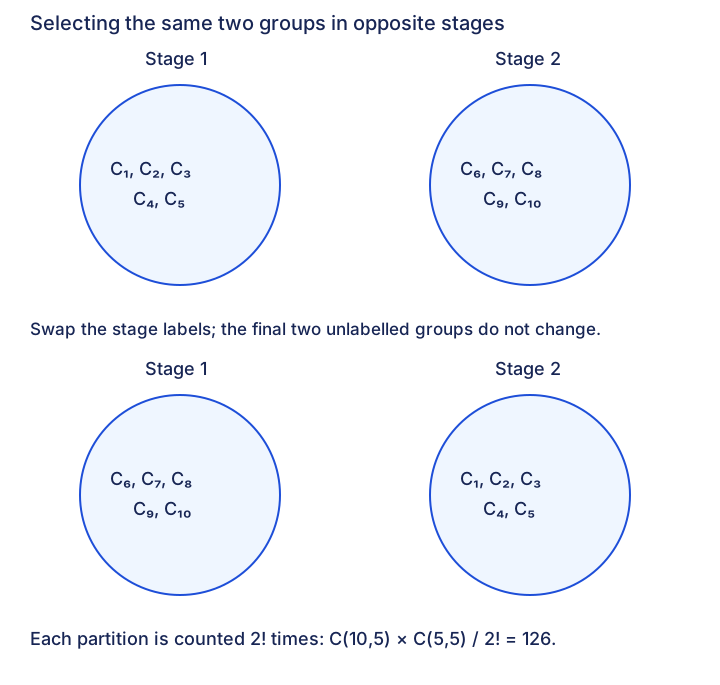
(ii) Divide out the two orders of the equal groups
Choosing a first 5-person set and then its remaining complement gives . But selecting C₁,…,C₅first and C₆,…,C₁₀second describes the same two unlabelled groups as selecting them in the opposite order. The source drawing shows these two stage orders. Divide by 2!: .
(iii) Only the two four-person groups can be interchanged
Choose 2 children from 10, then 4 from the remaining 8, then the last 4. The ordered-stage count is . The two 4-person groups are indistinguishable, so divide by 2!: the answer is . Do not divide by 3!: the 2-person group is distinguished by its size.
Compare your sketch
Expand diagramFit diagram to page
Use the scrollbars or arrow keys to inspect details.
Common mistakes
Divide only for permutations of unlabelled groups that represent the same partition. Equal-sized groups with different assigned names or functions would remain distinguishable.