Porisma

Worked solution

Keep the consonants of MINIMUM together

If the letters of the word MINIMUM are arranged in a line at random, in how many ways can this be done such that all the consonants are together?

CJC · Lecture · Example 12

Group the restricted letters first

The vowels are I,I,U and the consonants are M,M,M,N. Combine all four consonants into one object. The outer objects are now I,I,U,[MMMN].

How did this part go?

Count outer arrangements and arrangements inside the block

The 4 outer objects have two identical I copies, so they can be arranged in 4!/2!=124!/2!=12 ways. Inside the consonant block, the three M copies are identical, so there are 4!/3!=44!/3!=4 orders. Multiply: (4!/2!)(4!/3!)=12×4=48(4!/2!)(4!/3!)=12\times4=48. This implements the source tip: group according to the restriction, arrange the regrouped objects, then arrange the items within the block.

How did this part go?

Compare your sketch

Expand diagram

Use the scrollbars or arrow keys to inspect details.
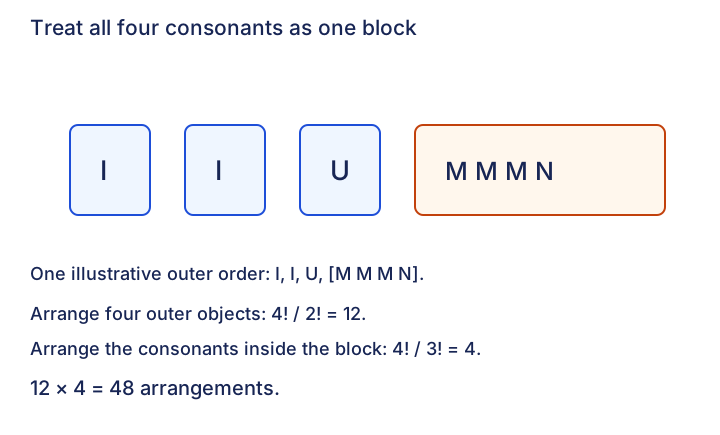
The source groups M,M,M,N into one block, leaving four outer objects I,I,U, and the block. Two I copies are identical, giving four factorial divided by two factorial outer arrangements. Inside the block, three M copies are identical, giving four factorial divided by three factorial orders. The shown outer order is illustrative, not fixed.

Common mistakes

A block is one object for the outer arrangement, but its internal orders must still be counted. Correct separately for the repeated I copies outside and repeated M copies inside.

Read the hint