Worked solution
Fill the most constrained digit position first
How many numbers between 3000 and 5000 can be formed using only the digits 1, 2, 3, 4 and 5 if (i) no digit is repeated, (ii) the digits can be repeated, (iii) no repetition is allowed and the numbers are even?
CJC · Lecture · Example 15
(i) Count four positions without repetition
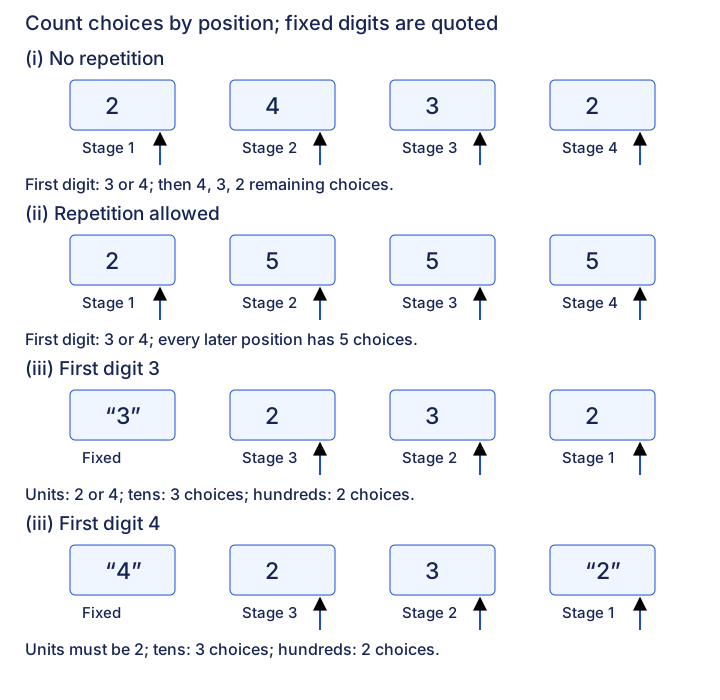
The thousands digit must be 3 or 4: 2 choices. The hundreds, tens and units then have 4, 3 and 2 remaining choices. Hence .
(ii) Allow repetition in each later position
The thousands digit still has 2 choices. Each later position independently has 5 choices: .
(iii) First digit 3: fill the units position next
The units digit is 2 or 4, giving 2 choices. Fill tens next with 3 remaining choices, then hundreds with 2. Thus . The displayed positional counts are fixed 3, then 2,3,2; the counting stages run units, tens, hundreds.
(iii) First digit 4: the units digit is forced
Without repetition, the units digit must be 2. Tens has 3 choices and hundreds has 2. The displayed row is fixed 4, then 2 choices,3 choices, fixed 2. This contributes .
(iii) Add the disjoint first-digit cases
There are even numbers. Follow the Teacher guidance: positions need not be filled left to right; usually begin with the most constrained position. Here fix the thousands digit to determine the available even units digits, then complete the middle positions.
Compare your sketch
Expand diagramFit diagram to page
Use the scrollbars or arrow keys to inspect details.
Common mistakes
The first digit changes the units choices in part (iii); do not multiply a single units count across both first-digit cases. Neither endpoint 3000 nor 5000 can be made because 0 is unavailable.