Worked solution
Arrange distinct people using blocks and gender patterns
In how many ways can 3 men and 3 women be arranged in a row so that (i) the women are always together, (ii) the men and women occupy alternate places, (iii) the two particular women are always separated by two men?
CJC · Lecture · Example 16
(i) Treat the three women as one block
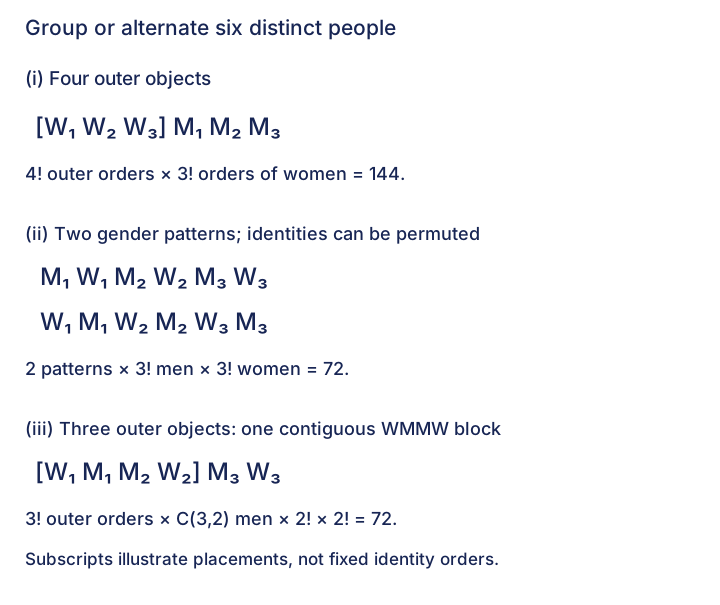
The outer objects are [W1,W2,W3],M1,M2,M3. Arrange these 4 objects in 4! ways and the women inside in 3! ways: .
(ii) Count both alternating gender patterns
The patterns are MWMWMW and WMWMWM. The source illustrates these with M1,W1,M2,W2,M3,W3 and W1,M1,W2,M2,W3,M3. Within either pattern permute the 3 distinct men and 3 distinct women independently. Thus .
(iii) Form the intended contiguous WMMW block
The source interprets the wording as exactly two men between the particular women, with nobody else between them. Choose the two men in ways, order them in 2! ways and choose which particular woman is at each end in 2! ways.
(iii) Arrange the three outer objects
The source illustration is [W1,M1,M2,W2],M3,W3. Arrange the block, remaining man and remaining woman in 3! ways. Total . The subscripted illustration does not fix identities or internal orders.
Compare your sketch
Expand diagramFit diagram to page
Use the scrollbars or arrow keys to inspect details.
Common mistakes
All six people are distinct. Part (iii) follows the source’s contiguous WMMW interpretation; the wording is not being expanded to allow additional people between the two women.