Worked solution
Reverse the conditioning in a dice table
A fair die is thrown twice. Find the probability that (i) the total score is 6, (ii) the first throw is even, (iii) the total score is 6 given that the first throw is even, (iv) the first throw is even given that the total score is 6.
CJC · Lecture · Example 4
(i) Read the five total-six cells
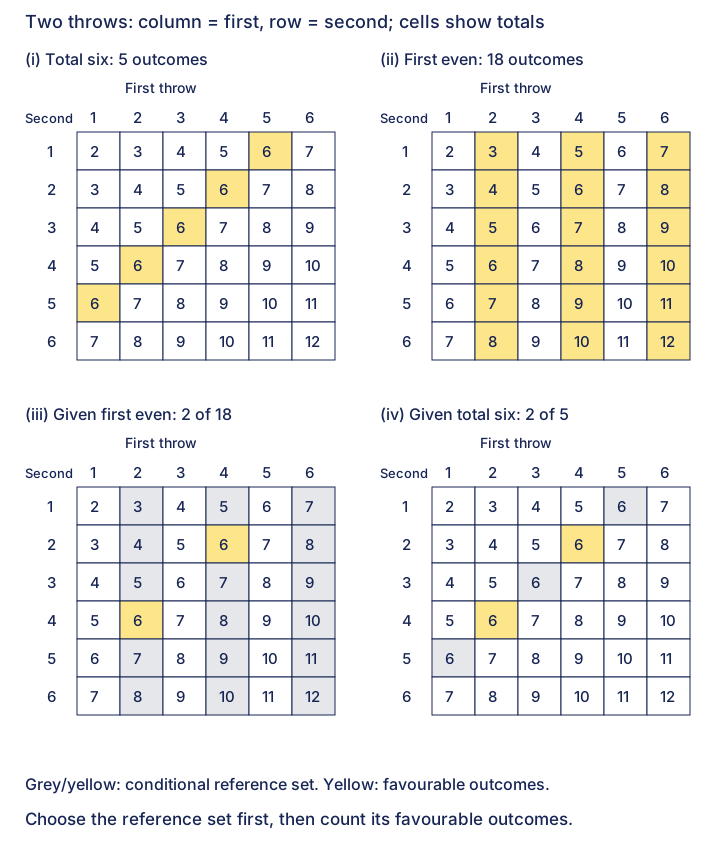
Use 36 equally likely ordered pairs. The first throw labels columns and the second labels rows; each table entry is their sum. Total 6 occurs at (1,5),(2,4),(3,3),(4,2),(5,1), so . The four displayed panels retain every sum-table entry and its relevant shading.
(ii) Count the even-first columns
Columns 2,4,6 each contain 6 outcomes, giving 18 in total. Hence .
(iii) Method 1: use the conditional formula
The two outcomes satisfying both conditions are (2,4) and (4,2), so the numerator from the outcome table is 2/36. The denominator is the result 1/2 from part (ii). Thus . The source recommends this probability formula.
(iii) Method 2: choose the reference set before the event
First identify the 18 even-first outcomes as the reduced sample space. Then mark the 2 total-six outcomes within it. Therefore the count ratio is 2/18=1/9. Follow the Teacher guidance: identify the reference set first, then its favourable subset. In the diagram grey/yellow marks the reference set and yellow marks favourable cells. Counting works here because those 18 outcomes are equally likely; it is not a universal shortcut for arbitrary outcome spaces.
(iv) Method 1: change the denominator
The overlap is still 2/36, but the condition is now total six, with probability 5/36 from part (i). Hence , incorporating the Teacher completion.
(iv) Method 2: restrict to the five total-six cells
First identify the 5 total-six outcomes as the reference set, then the 2 even-first outcomes among them. The reduced-space count is 2/5. The same overlap produces a different conditional probability because the reference set changed.
Compare your sketch
Expand diagramFit diagram to page
Use the scrollbars or arrow keys to inspect details.
Common mistakes
Do not swap the given event and the desired event: the numerators agree but the denominators 18 and 5 differ. Table entries are sums; ordered cells, not distinct sums, are the equally likely outcomes. Assume independent repeated rolls of the fair die.