Porisma

Worked solution

Subtract Venn regions before using independence

In a certain sample space, A and B are independent, P(A∪B)=4/9P(A\cup B)=4/9 and P(A∩B′)=5/18P(A\cap B')=5/18. Calculate (i) P(B), (ii) P(A), (iii) P(A∪B′)P(A\cup B').

CJC · Lecture · Example 5

(i) Remove the A-only part from the union

The union partitions into B and A∩B′A\cap B'. Therefore P(B)=P(A∪B)−P(A∩B′)=4/9−5/18=1/6P(B)=P(A\cup B)-P(A\cap B')=4/9-5/18=1/6. The accompanying regions implement the Teacher guidance: the B region is what remains after subtracting A-only from the union.

How did this part go?

(ii) Substitute the independent intersection into the addition rule

P(A∪B)=P(A)+P(B)−P(A∩B)=P(A)+P(B)−P(A)P(B)P(A\cup B)=P(A)+P(B)-P(A\cap B)=P(A)+P(B)-P(A)P(B). Hence 4/9=P(A)+1/6−P(A)/64/9=P(A)+1/6-P(A)/6, so 4/9−1/6=(5/6)P(A)4/9-1/6=(5/6)P(A) and P(A)=1/3P(A)=1/3.

How did this part go?

(iii) Find the one excluded region

The complement of A∪B′A\cup B' is B∩A′B\cap A', the B-only region. As the Teacher split diagram suggests, subtract the overlap from all of B: P(B∩A′)=P(B)−P(A∩B)=P(B)−P(A)P(B)=1/6−(1/3)(1/6)=1/9P(B\cap A')=P(B)-P(A\cap B)=P(B)-P(A)P(B)=1/6-(1/3)(1/6)=1/9.

How did this part go?

(iii) Take its complement

P(A∪B′)=1−P(B∩A′)=1−1/9=8/9P(A\cup B')=1-P(B\cap A')=1-1/9=8/9. The shaded target includes A and everything outside B; it excludes only the B-only region.

How did this part go?

Compare your sketch

Expand diagram

Use the scrollbars or arrow keys to inspect details.
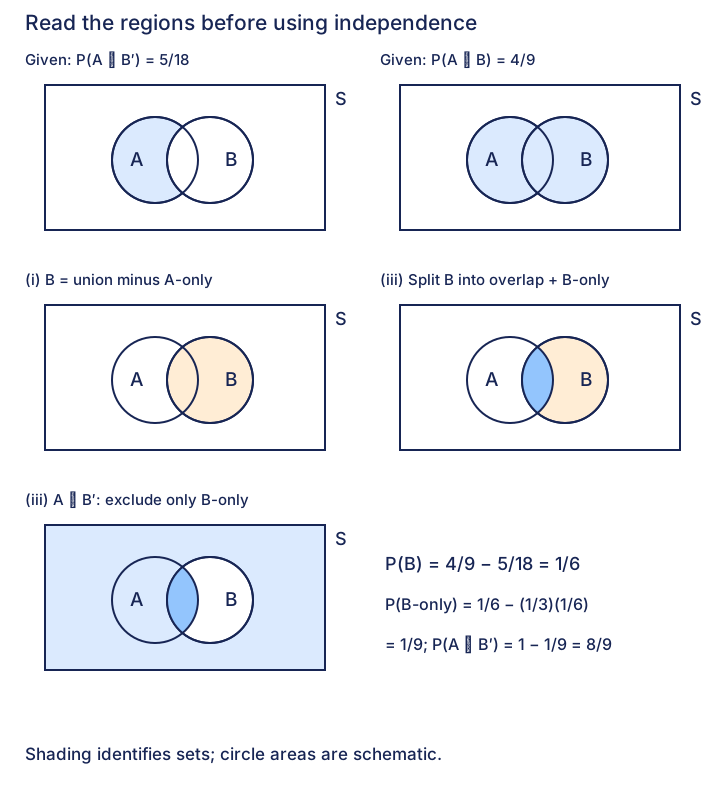
Five source constructions: A outside B has probability 5/18; union has probability 4/9; B remains after subtracting A-only from union, implementing the Teacher visual derivation; B splits into its overlap with A and B-only, implementing the Teacher difference diagram; A union not-B is all sample space except B-only. In the split diagram blue is overlap and orange B-only. In the final panel all shaded regions are included; B-only is white. Areas are schematic.

Common mistakes

A union not-B is not the complement of A union B. Identify the excluded B-only region. Use independence only for the intersection-product step, not for the initial region subtraction.

Read the hint