Worked solution
Find a sample size for a central normal interval
For an independent random sample from :
(i) State the distribution of .
(ii) Find the sample size required to ensure that the probability that is within 0.1 of is greater than 0.95.
CJC · Lecture · Example 6
(i) Standardise the sample mean
exactly and . Thus the event is .
(ii) Method 1: inverse normal
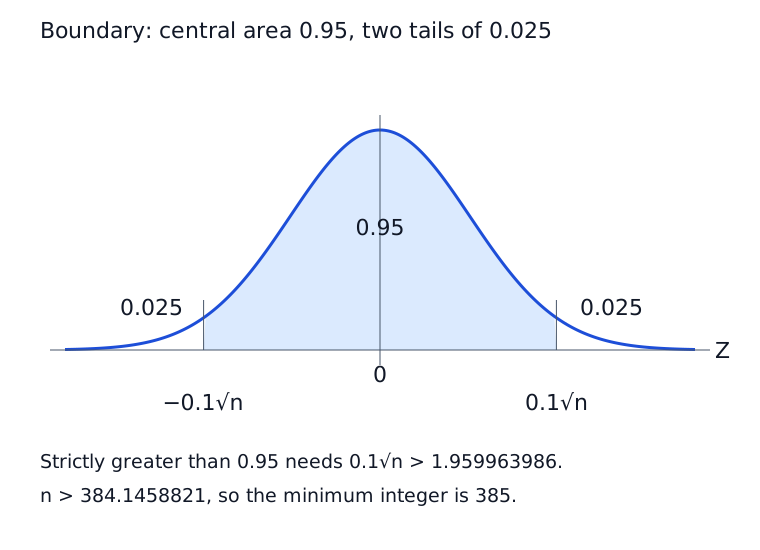
A central area 0.95 leaves 0.025 in each tail. The source’s DISTR → invNorm, area .95, μ 0, σ 1, CENTER gives . To make the probability strictly larger, , hence . The least integer is 385. The source rounds the intermediate bound to 384.14; it leads to the same integer.
(ii) Method 2: calculator table
Enter and inspect integer . The printed table is:
| n | Central probability as printed |
|---|---|
| 384 | 0.95 |
| 385 | 0.9503 |
| 386 | 0.9505 |
At 384 the unrounded value is 0.9499564788, below .95 despite its display rounding. At 385 it is 0.9502540093. Monotonic widening of the central interval proves 385 is minimal.
Compare your sketch
Expand diagramFit diagram to page
Use the scrollbars or arrow keys to inspect details.
Common mistakes
The source sketch shows the equality boundary: central area .95 and tails .025. The requested strict inequality requires an interval wider than that boundary, not acceptance of the rounded .95 at n384.