Worked solution
Count travelled legs in a bouncing-ball model
A student drops a ball made of a new compound from cm onto a hard surface. Each rebound reaches of the previous height.
(i) Find the distance travelled when it reaches the highest point after the fourth bounce, to the nearest centimetre.
(ii) The ball is considered to have stopped when a bounce first reaches a height below cm. Find the number of bounces and the total distance travelled, to the nearest centimetre.
[2017/SP/I/4]
CJC · Sequences and Series · Example 35 (Kinematics)
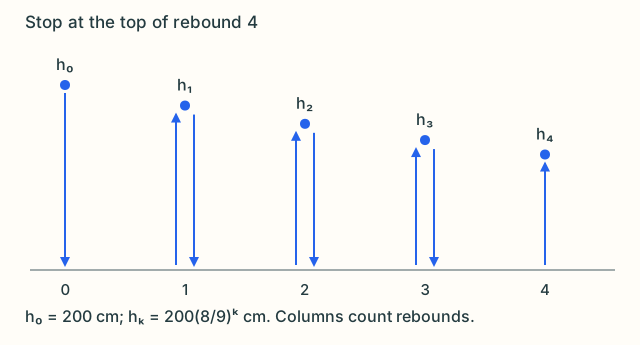
(i) Distance to the fourth rebound apex
Answer
cm (nearest cm).
Draw the legs and identify the height pattern
The source callout recommends a diagram, a table and observing the pattern. Put q=8/9. The initial descent is 200 cm, rebounds 1–3 each contribute an ascent and a descent, and rebound 4 contributes only its ascent.
Substitute before rounding
Keep the fourth height singly rather than doubling every rebound.
(ii) Stopping threshold and distance
Answer
bounces; cm (nearest cm).
Solve the strict height inequality
The logarithm of 8/9 is negative, so dividing reverses the inequality. The source cutoff is displayed as 84.082.
Sum the completed up-and-down rebounds
The source sums 84 paired rebound heights; after the 85th floor contact these completed legs have been travelled. The GP inside the bracket has first term 8/9, ratio 8/9 and 84 terms.
Include the tiny final ascent when ending at its apex
The lecturer notes that h85 is negligible at nearest-centimetre precision. Its comparison screen shows both totals: the floor-contact total and the apex total. Retain that rounding justification rather than treating the omitted ascent as exactly zero.
Compare your sketch
Expand diagramFit diagram to page
Use the scrollbars or arrow keys to inspect details.
Solution notes
The source table labels its heights in metres, but the question and computations use centimetres. It also describes the top-to-floor distance: the same height is travelled upwards after each contact. Here h_k consistently denotes the rebound height in cm. The source’s examiner-report note recommends initial height plus twice the other completed heights; the last endpoint still determines whether a final height is counted once.