Worked solution
Move a reciprocal asymptote upwards
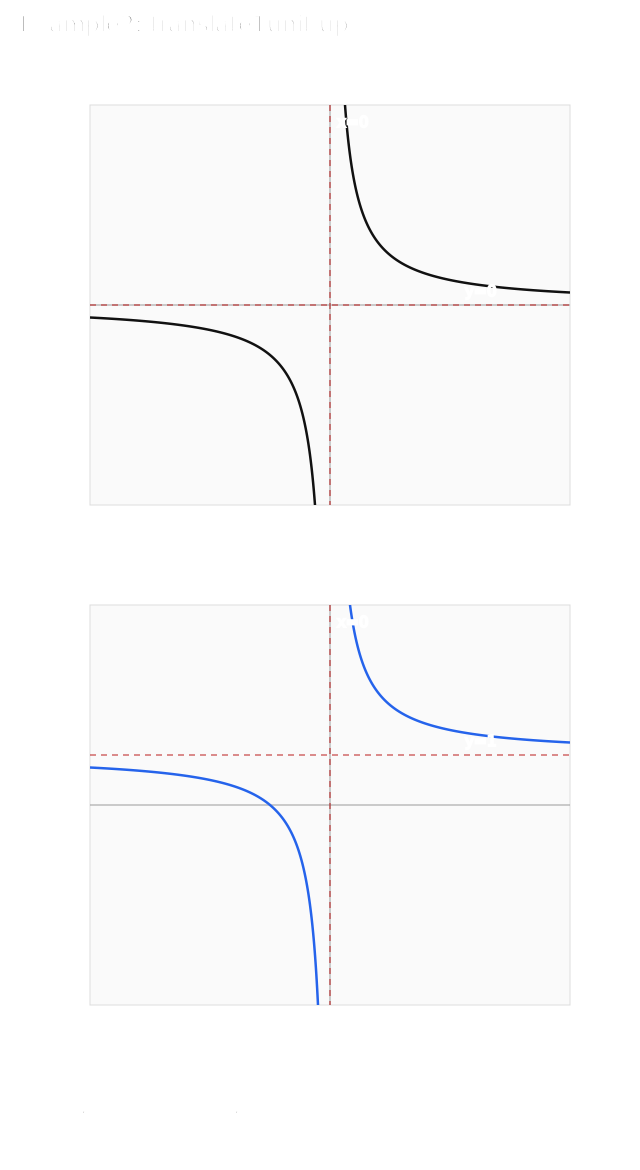
State the transformation which transforms to . On separate diagrams, sketch the two graphs, stating the equations of any asymptotes.
CJC · Transformations · Example 2
State the transformation
Answer
Translate 1 unit in the positive y-direction.
Replace y with , giving and hence . The point mapping is .
Sketch separately and state the asymptotes
Answer
Original: , . Translated: , .
Draw the original reciprocal separately from the translated graph. The shifted right branch lies above y1, and the left branch below y1, crossing the x-axis at −1 (an independent coordinate check). Transform the old horizontal asymptote with the same replacement: . The vertical asymptote is independent of y and remains unchanged. The Teacher completes the translated curve label, asymptote labels and replacement stage.
Expand diagramFit diagram to page
Use the scrollbars or arrow keys to inspect details.