Worked solution
Reflect a rational graph in the x-axis
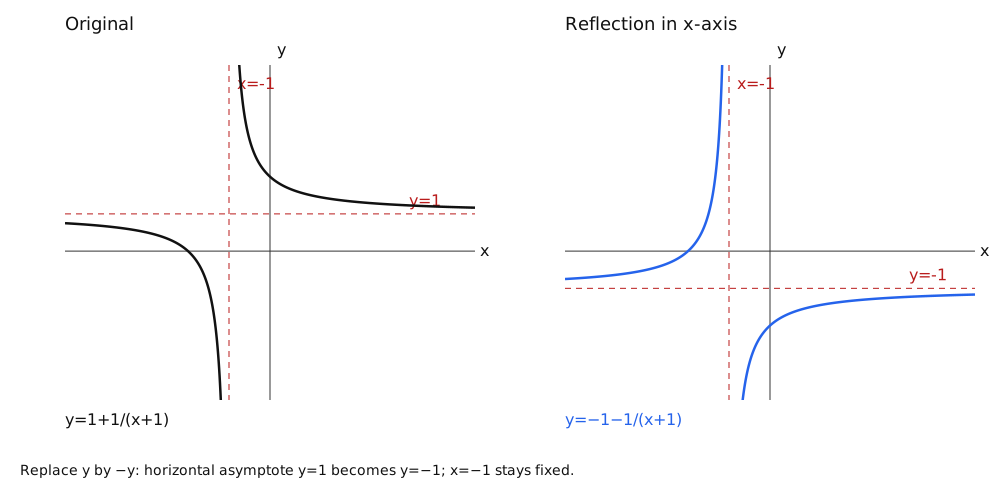
State the transformation which transforms to . On separate diagrams, sketch the two graphs, stating the equations of any asymptotes.
CJC · Transformations · Example 5
State the reflection
Answer
Reflection in the x-axis.
Replace y by : , giving . The Teacher supplies this intermediate equation and transformation.
How did this part go?
Sketch separately and transform the asymptotes
Answer
Original: , . Reflected: , .
Keep both branches in each separate diagram. The source derives the new horizontal asymptote by replacing y in : , hence . The vertical asymptote is independent of y and remains unchanged.
Expand diagramFit diagram to page
Use the scrollbars or arrow keys to inspect details.
How did this part go?