Worked solution
Transform a cubic and find its exact intercepts
The curve is transformed by a translation of 2 units in the positive x-direction, followed by a stretch with scale factor parallel to the y-axis, followed by a translation of 6 units in the negative y-direction. Find the equation of the new curve in the form and the exact coordinates of the points where this curve crosses the x- and y-axes. Sketch the new curve.
[N2010/1/5(i)]
CJC · Transformations · Example 11
Derive the new equation
Answer
.
The Teacher completes the intermediate equations and asks that the replacements be demonstrated when necessary. The printed word “stretch” uses factor ; it halves vertical distances.
Translate right two
Replace x by .
Halve vertical distances
Replace y by .
Translate down six
Replace y by .
Find both exact intercepts
Answer
and .
For the y-intercept, set : . For the x-intercept, set : , so and . These coordinates are exact; a decimal approximation does not replace the cube root.
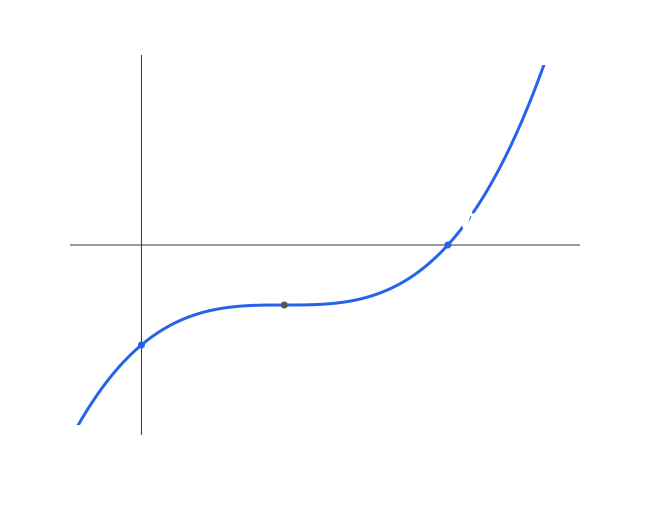
Sketch the transformed cubic
Answer
An increasing cubic crossing and .
Retain the source curve and both labelled intercepts. Independently, its stationary inflection is and ; this explains the horizontal flattening and the increasing shape.
Expand diagramFit diagram to page
Use the scrollbars or arrow keys to inspect details.