Worked solution
Take the modulus of a cubic output
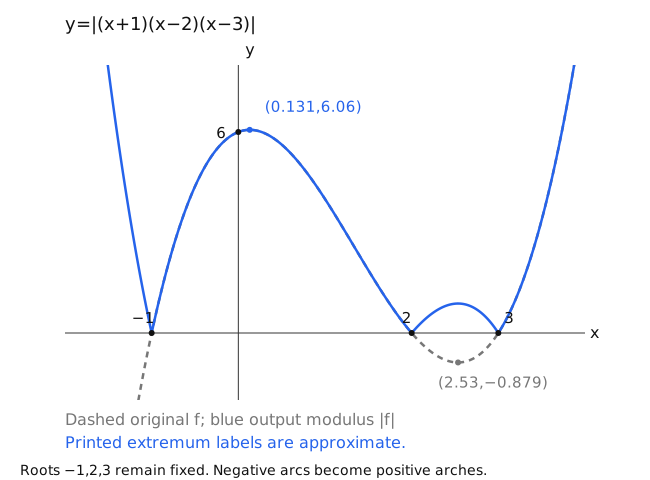
Sketch from .
CJC · Transformations · Example 13
Choose which arcs to reflect
Answer
Reflect and ; retain and .
Independently checking the signs of the three factors gives these intervals. Zeros remain . Negative outputs change sign, while positive outputs stay fixed.
How did this part go?
Retain the source graph labels
Answer
All new outputs are non-negative; the original negative trough becomes a positive arch.
The source labels the original extrema approximately and . Retain these printed approximate readings, without treating rounded coordinates as exact. The first stays above the axis; the second reflects to approximately . The original negative arcs remain dashed in the reconstruction.
Expand diagramFit diagram to page
Use the scrollbars or arrow keys to inspect details.
How did this part go?