Porisma

Worked solution

Fold a rational graph above the x-axis

On separate diagrams, sketch y=(−2x+a)/(x+a)y=(-2x+a)/(x+a) and y=∣(−2x+a)/(x+a)∣y=|(-2x+a)/(x+a)|, where a>0a>0.

CJC · Transformations · Example 14

Sketch the original rational function

Answer

Asymptotes x=−ax=-a, y=−2y=-2; intercepts (0,1)(0,1) and (a/2,0)(a/2,0).

The Teacher completes the Student asymptote/intercept working: at x=0x=0, y=1y=1; at y=0y=0, −2x+a=0-2x+a=0 gives x=a/2x=a/2. Independently, rewrite (−2x+a)/(x+a)=−2+3a/(x+a)(-2x+a)/(x+a)=-2+3a/(x+a). The numerator at x=−ax=-a is 3a≠03a\ne0, so the vertical asymptote is genuine.

How did this part go?

Sketch the output modulus separately

Answer

Asymptotes x=−ax=-a, y=2y=2; intercepts stay (0,1),(a/2,0)(0,1),(a/2,0).

The Teacher completes the second, blank Student graph. Reflect the negative branch x<−ax<-a and the negative tail x>a/2x>a/2 in the x-axis; retain −a<x≤a/2-a<x\le a/2. Both sides of the vertical asymptote now tend upwards. The point (a/2,0)(a/2,0) is a corner minimum. The diagrams use the horizontal coordinate x/ax/a, so their symbolic labels hold for every a>0a>0.

Expand diagram

Use the scrollbars or arrow keys to inspect details.
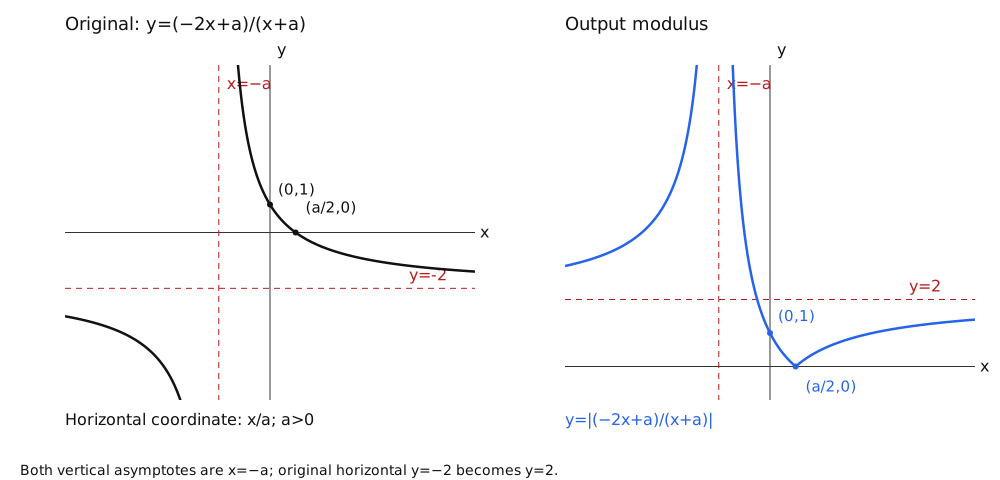
Separate original rational graph and its output modulus for a>0, horizontal positions scaled by a. Original asymptotes x=−a,y=−2; modulus x=−a,y=2. Both intercept (0,1),(a/2,0). Modulus tends to positive infinity on both sides of x=−a.
How did this part go?