Worked solution
Take the modulus of a cubic input
Sketch from .
CJC · Transformations · Example 15
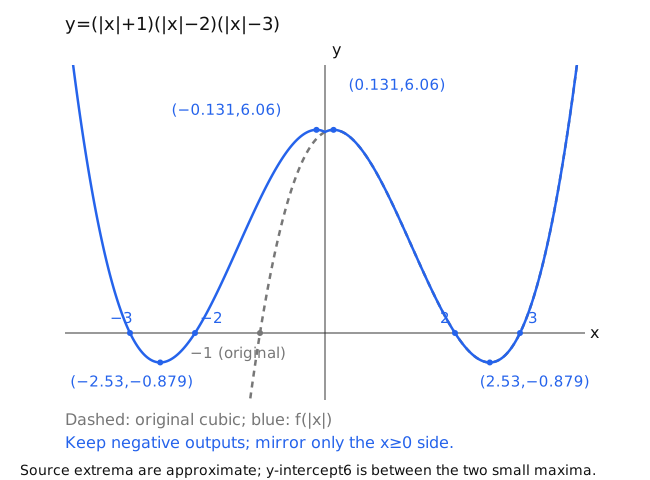
Retain and mirror the right-hand side
Answer
The new roots are ; the y-intercept remains .
Discard the original portion, including its root . Keep the portion with , then reflect it in the y-axis. Negative outputs between 2 and 3 stay negative and also appear between −3 and −2; input modulus does not make all outputs non-negative.
How did this part go?
Preserve every printed extremum label
Answer
The right-hand extrema have matching mirror images on the left.
The source labels and , with mirror labels and . These are retained printed approximate coordinates. Independently, and the one-sided slopes change sign at 0, giving a corner minimum there; the nearby maxima are slightly higher.
Expand diagramFit diagram to page
Use the scrollbars or arrow keys to inspect details.
How did this part go?