Porisma

Worked solution

Mirror a supplied two-branch sketch

Sketch y=f(∣x∣)y=f(|x|) given the graph of y=f(x)y=f(x).

Expand diagram

Use the scrollbars or arrow keys to inspect details.
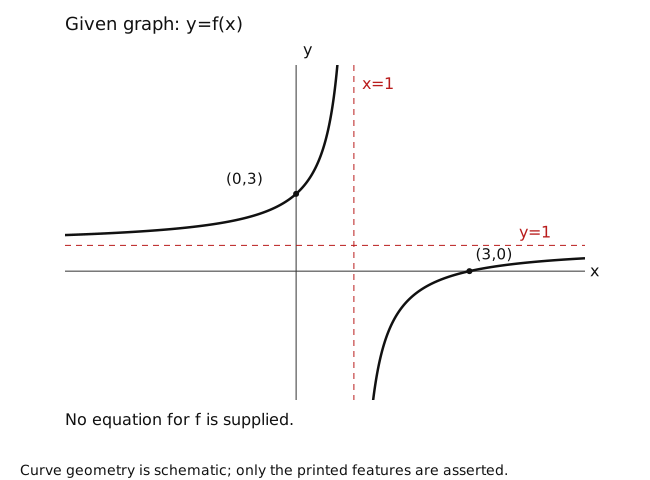
Given schematic graph y=f(x): two branches, vertical asymptote x=1, horizontal asymptote y=1, y-intercept (0,3) and x-intercept (3,0). Left branch increases to positive infinity at 1; right branch increases from negative infinity toward y=1. No formula is supplied.

CJC · Transformations · Example 16

Retain the given positive-input features

Answer

The new sketch has vertical asymptotes x=±1x=\pm1, horizontal asymptote y=1y=1, and roots x=±3x=\pm3.

The given sketch has vertical asymptote x=1x=1, horizontal asymptote y=1y=1, y-intercept 3 and x-intercept 3. Retain only its x≥0x\ge0 portion, then mirror it in the y-axis. The Teacher fills the blank Student answer axes. Both sides near each new vertical asymptote must retain the source branch directions.

Expand diagram

Use the scrollbars or arrow keys to inspect details.
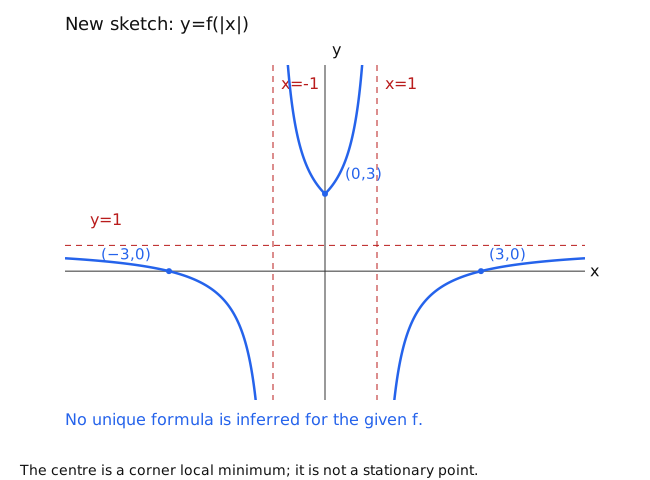
Symmetric reconstruction of f(|x|) from the given graph: vertical asymptotes x=−1 and 1, horizontal asymptote y=1, roots −3 and 3, central point (0,3), positive central branches tending upward to the poles, outer branches tending downwards at poles and approaching y=1 from below.
How did this part go?

Distinguish a corner minimum from a stationary point

Answer

(0,3)(0,3) is a corner local minimum, not a differentiable stationary point.

The Teacher note says “(0,3) is not a turning point in this example.” Preserve that note with a terminology qualification: the supplied retained branch increases immediately to the right of 0, and its mirror decreases immediately to the left. Consequently the centre is a local minimum in the usual local-extremum sense; the corner is not a differentiable stationary point. Reading the note as denying any local minimum would contradict the drawn graph. No unique formula for f is given or inferred.

How did this part go?