Worked solution
Move the parabola horizontally
Use a graphing calculator to sketch:
Copy the curves. What do you observe about the curves?
CJC · Transformations · Horizontal translation activity
Sketch the three curves
Answer
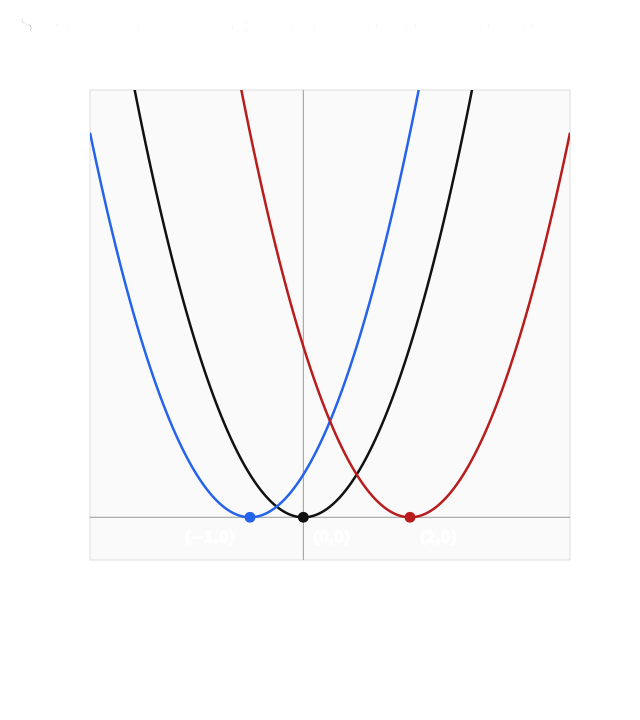
Upward parabolas with vertices , and .
Plot all three on the same axes. The Teacher labels the shifted vertices and the two translated equations; the Student has the curves but leaves those observation coordinates blank. A graphing calculator can display the three entries together; no further key sequence is specified on this page.
Expand diagramFit diagram to page
Use the scrollbars or arrow keys to inspect details.
Describe what is preserved and what moves
Answer
Shape and size are preserved; the vertex moves left 1 or right 2.
Replacing by gives a translation 1 unit in the negative x-direction. Replacing it by gives a translation 2 units in the positive x-direction. Thus the original minimum becomes or respectively. Both are rigid translations, so the shape and size stay unchanged.