Worked solution
Scale input distances about the y-axis
Use a graphing calculator to sketch:
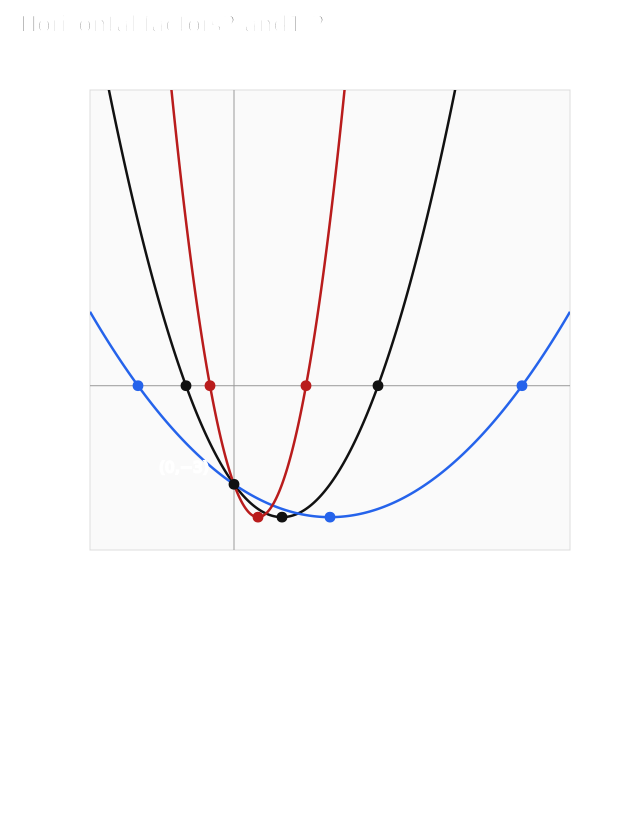
Copy the curves. What do you observe about the curves?
CJC · Transformations · Horizontal scaling activity
Sketch and retain the coordinate table
Answer
Vertices , , ; common y-intercept .
Let . Draw the original, and on the same axes. The Teacher completes the Student table:
| Curve | Minimum | y-intercept | x-intercepts |
|---|---|---|---|
Expand diagramFit diagram to page
Use the scrollbars or arrow keys to inspect details.
How did this part go?
Explain the scale factors
Answer
doubles horizontal distances; halves them.
Replace x with x/2 to scale parallel to the x-axis by factor 2. Replace x with 2x to scale parallel to that axis by factor 1/2. The source says the shape is preserved: all three remain parabolas. This is not rigid congruence; their widths change. The y-coordinates stay fixed, while each point’s x-coordinate is doubled or halved.
How did this part go?