Worked solution
Mirror the non-negative input side
Use a graphing calculator to sketch (1) and (2) . Copy the curves. What do you observe about the curves?
CJC · Transformations · Input modulus activity
Sketch and compare the logarithmic curves
Answer
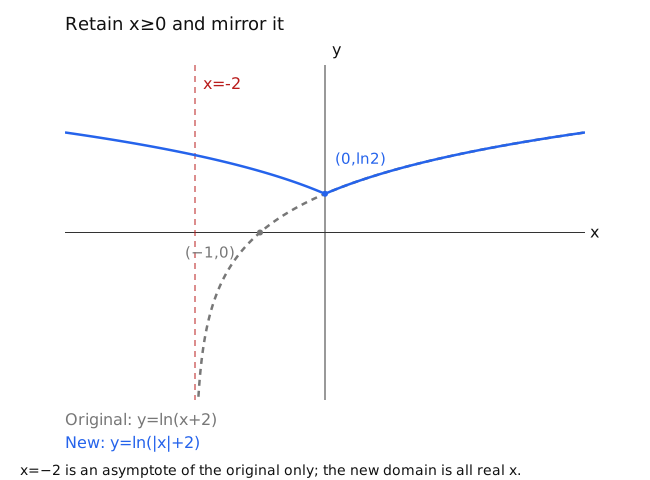
Retain for and mirror that portion in the y-axis.
The source graph retains the original x-intercept , original vertical asymptote and common y-intercept . The new graph is symmetric about the y-axis. Independently, means its real domain is all x and its range is ; the discarded negative-input side does not create an asymptote at .
Expand diagramFit diagram to page
Use the scrollbars or arrow keys to inspect details.
Use the piecewise input definition
Answer
The source defines for and for . Its two steps retain the original portion for and reflect this retained portion about the y-axis. Thus the result is symmetric about that axis wherever the inputs are valid. The later “Hence to sketch” line omits the modulus bars in both originals; the surrounding definition and steps establish that it refers to . Keep the original typo in the native transcription.