Worked solution
Reflect output coordinates in the x-axis
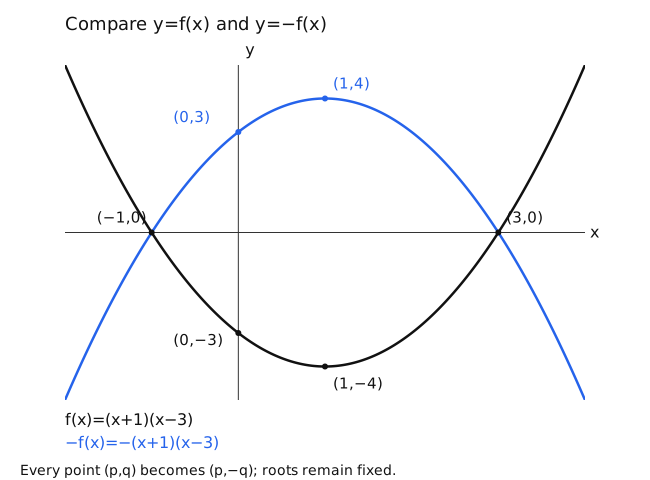
Use a graphing calculator to sketch (1) and (2) . Copy the curves. What do you observe about the curves?
CJC · Transformations · Reflection in x-axis activity
Sketch and compare the coordinates
Answer
The minimum becomes a maximum ; the roots stay and .
The Teacher completes the Student observation table. Retain both curves on the same axes.
| Curve | Stationary point | y-intercept | x-intercepts |
|---|---|---|---|
| Minimum | |||
| Maximum |
Expand diagramFit diagram to page
Use the scrollbars or arrow keys to inspect details.
How did this part go?
Explain the reflection
Answer
reflects in the x-axis: .
Replace y by in to obtain , hence . Each output changes sign while the input stays fixed. As the source remark states, this is signed scaling by parallel to the y-axis. Points on the x-axis stay fixed.
How did this part go?