Porisma

Worked solution

Translate a straight line in two directions

Given f(x)=x+1f(x)=x+1, sketch on separate diagrams (a) y=f(x)+2y=f(x)+2 and (b) y=f(x−3)y=f(x-3).

CJC · Transformations · Self-Practice 1

(a) Sketch f(x)+2

Answer

y=x+3y=x+3, with intercepts (−3,0)(-3,0) and (0,3)(0,3).

Independently derived: f(x)+2=(x+1)+2=x+3f(x)+2=(x+1)+2=x+3. Translate the original straight line upwards 2 units; the gradient stays 1. This page provides no printed self-practice solution in either copy.

Expand diagram

Use the scrollbars or arrow keys to inspect details.
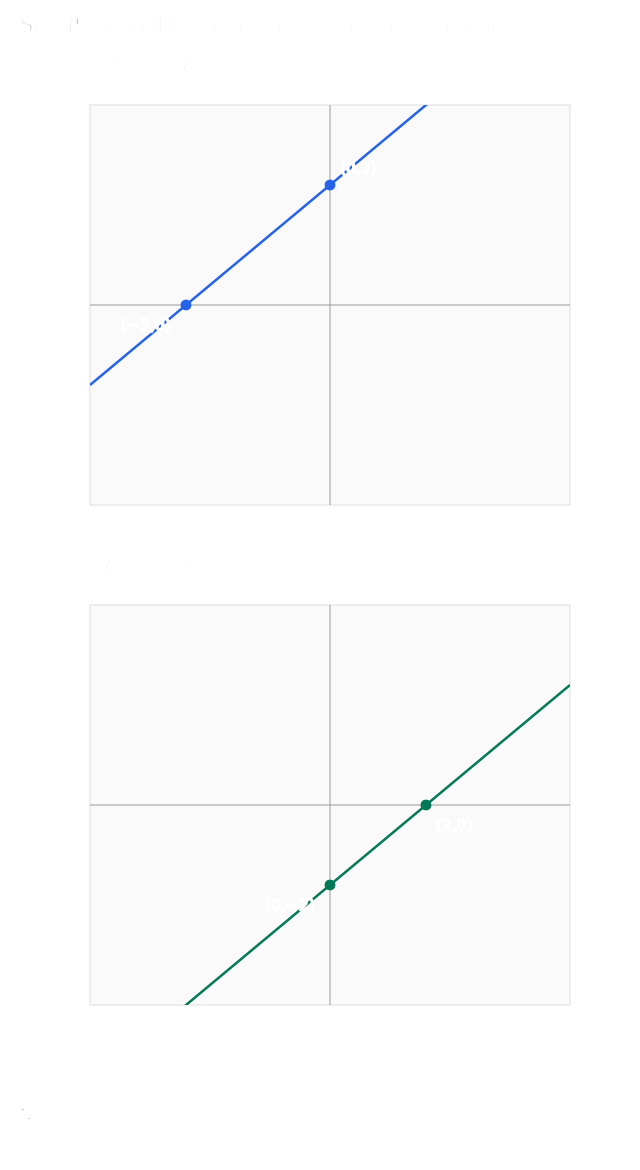
Two independent sketches: linea y=x+3 through (−3,0),(0,3); lineb y=x−2 through (2,0),(0,−2). Both gradients 1, continuing in both directions. Source asks separate diagrams; answers independently derived.
How did this part go?

(b) Sketch f(x−3)

Answer

y=x−2y=x-2, with intercepts (2,0)(2,0) and (0,−2)(0,-2).

Independently derived: f(x−3)=(x−3)+1=x−2f(x-3)=(x-3)+1=x-2. Translate the original line 3 units to the right; the gradient stays 1. Draw it on its own axes, as requested. Do not confuse subtracting 3 from the input with the previous upward translation.

How did this part go?