Worked solution
Two scalings of the same straight line
Given , sketch on separate diagrams (a) and (b) .
CJC · Transformations · Self-Practice 2
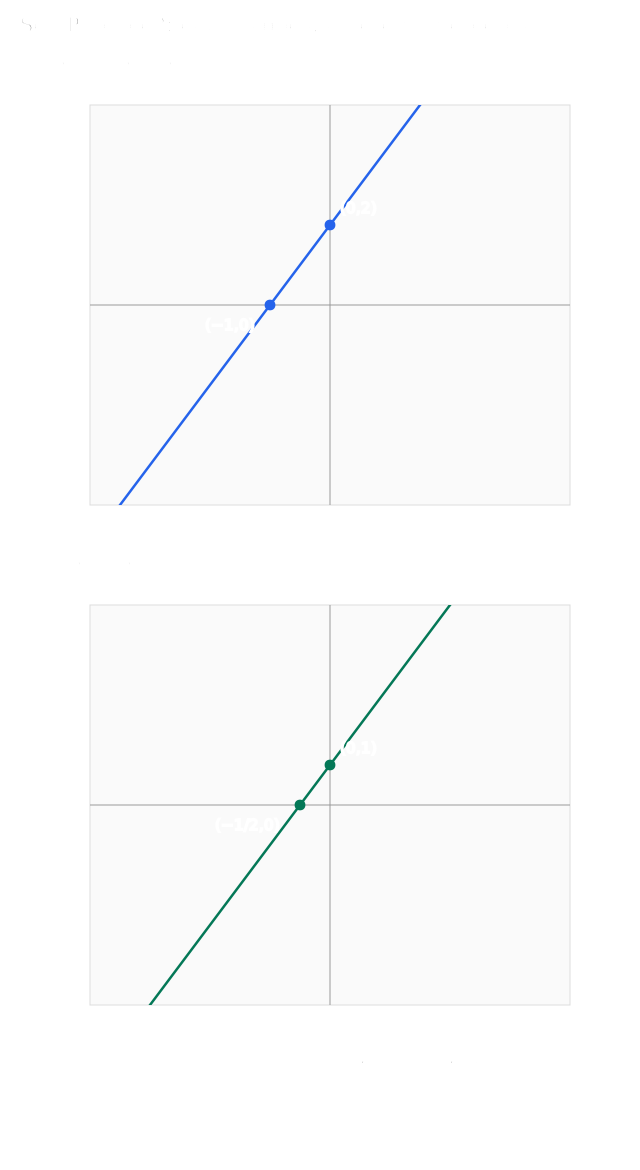
(a) Sketch 2f(x)
Answer
, intercepts and .
Independently derived: . Double every output, including the y-intercept; the x-intercept stays −1. Neither copy prints a self-practice solution here.
Expand diagramFit diagram to page
Use the scrollbars or arrow keys to inspect details.
How did this part go?
(b) Sketch f(2x)
Answer
, intercepts and .
Independently derived: . Halve input distances from the y-axis; the x-intercept moves to −1/2 and the y-intercept stays 1. Both new lines have gradient 2 but distinct y-intercepts. Draw separate diagrams as requested.
How did this part go?