Porisma

Worked solution

Choose both angle vectors from the same vertex

A,B,CA,B,C have position vectors i+2j+3k\mathbf i+2\mathbf j+3\mathbf k, i+j+k\mathbf i+\mathbf j+\mathbf k and 2i+3j−2k2\mathbf i+3\mathbf j-2\mathbf k respectively. Find ∠ABC\angle ABC to the nearest 0.1∘0.1^\circ.

CJC · Vectors Basic · Example 13

Answer

∠ABC=118.6∘\angle ABC=118.6^\circ.

Compare your reasoning

Start both displacements at B

BA→=OA→−OB→=(123)−(111)=(012),BC→=OC→−OB→=(23−2)−(111)=(12−3).\begin{aligned}\overrightarrow{BA}&=\overrightarrow{OA}-\overrightarrow{OB}=\begin{pmatrix}1\\2\\3\end{pmatrix}-\begin{pmatrix}1\\1\\1\end{pmatrix}=\begin{pmatrix}0\\1\\2\end{pmatrix},\\\overrightarrow{BC}&=\overrightarrow{OC}-\overrightarrow{OB}=\begin{pmatrix}2\\3\\-2\end{pmatrix}-\begin{pmatrix}1\\1\\1\end{pmatrix}=\begin{pmatrix}1\\2\\-3\end{pmatrix}.\end{aligned}

The middle letter names the angle vertex. BA and BC both point away from B, implementing the repeated Teacher guidance.

Find the two lengths

∣BA→∣=02+12+22=5,∣BC→∣=12+22+(−3)2=14|\overrightarrow{BA}|=\sqrt{0^2+1^2+2^2}=\sqrt5,\qquad|\overrightarrow{BC}|=\sqrt{1^2+2^2+(-3)^2}=\sqrt{14}

These are scalar magnitudes, not new displacement vectors.

Use the signed scalar product

BA→⋅BC→=∣BA→∣∣BC→∣cos⁡∠ABC,(012)⋅(12−3)=514cos⁡∠ABC,2−6=514cos⁡∠ABC,∠ABC=cos⁡−1 ⁣(−470)≈118.6∘.\begin{aligned}\overrightarrow{BA}\cdot\overrightarrow{BC}&=|\overrightarrow{BA}||\overrightarrow{BC}|\cos\angle ABC,\\\begin{pmatrix}0\\1\\2\end{pmatrix}\cdot\begin{pmatrix}1\\2\\-3\end{pmatrix}&=\sqrt5\sqrt{14}\cos\angle ABC,\\2-6&=\sqrt5\sqrt{14}\cos\angle ABC,\\\angle ABC&=\cos^{-1}\!\left(-\frac4{\sqrt{70}}\right)\approx118.6^\circ.\end{aligned}

Both away or both towards is valid; reversing just one direction produces the supplementary angle.

How did this question go?

Compare your sketch

Expand diagram

Use the scrollbars or arrow keys to inspect details.
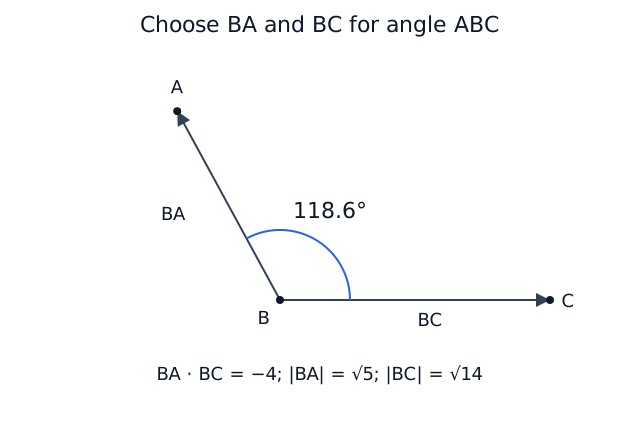
Two directed rays leave B towards A and C, with an obtuse included angle of 118.6 degrees. This is a two-dimensional view of the plane of the given three-dimensional displacements BA=(0,1,2), BC=(1,2,−3), not a coordinate projection or new coordinates.

Solution notes

Both copies print the complete calculation. The small source sketch looks acute and only illustrates arrow choice; the accessible figure shows the calculated obtuse angle.