Porisma

Worked solution

Relate parallelogram and triangle areas

A parallelogram ABCDABCD has three vertices A(2,1,0)A(2,1,0), B(−2,−3,0)B(-2,-3,0) and D(0,2,4)D(0,2,4). Find the area of the parallelogram and the area of triangle ABDABD.

CJC · Vectors Basic · Example 18

Answer

Parallelogram: 4414\sqrt{41} square units. Triangle ABDABD: 2412\sqrt{41} square units.

Compare your reasoning

Form adjacent sides from the same vertex

AB→=(−2−30)−(210)=(−4−40),AD→=(024)−(210)=(−214)\overrightarrow{AB}=\begin{pmatrix}-2\\-3\\0\end{pmatrix}-\begin{pmatrix}2\\1\\0\end{pmatrix}=\begin{pmatrix}-4\\-4\\0\end{pmatrix},\quad\overrightarrow{AD}=\begin{pmatrix}0\\2\\4\end{pmatrix}-\begin{pmatrix}2\\1\\0\end{pmatrix}=\begin{pmatrix}-2\\1\\4\end{pmatrix}

Position vectors must first become the side displacements AB and AD.

Use the magnitude of the cross product

∣AB→×AD→∣=∣−4[(110)×(−214)]∣=4∣(4−43)∣=441.\begin{aligned}|\overrightarrow{AB}\times\overrightarrow{AD}|&=\left|-4\left[\begin{pmatrix}1\\1\\0\end{pmatrix}\times\begin{pmatrix}-2\\1\\4\end{pmatrix}\right]\right|\\&=4\left|\begin{pmatrix}4\\-4\\3\end{pmatrix}\right|=4\sqrt{41}.\end{aligned}

The Teacher factors −4 from AB, then takes its absolute value outside the norm. The inner column (4,−4,3) is not AB×AD itself.

Halve the area for the diagonal triangle

Area⁡(ABCD)=441,Area⁡(ABD)=12(441)=241\operatorname{Area}(ABCD)=4\sqrt{41},\qquad\operatorname{Area}(ABD)=\frac12(4\sqrt{41})=2\sqrt{41}

Diagonal BD divides ABCD into two equal-area triangles. The cross-product vector is (−16,16,−12); its length is the parallelogram area.

How did this question go?

Compare your sketch

Expand diagram

Use the scrollbars or arrow keys to inspect details.
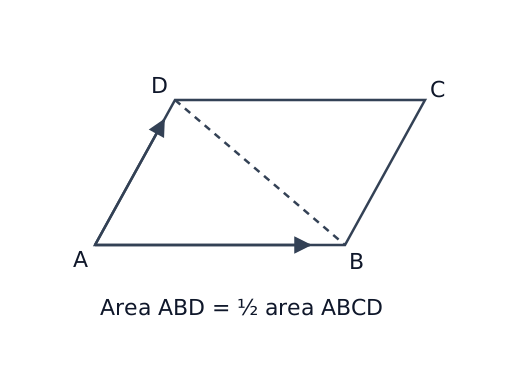
Schematic parallelogram ABCD with A bottom left, B bottom right, D top left, C top right. Adjacent arrows AB and AD start at A; dashed diagonal DB divides the parallelogram into equal-area triangles ABD and BCD. This is not a projection of the given coordinates.

Common mistakes

A cross product is a vector; its magnitude is a scalar area. Triangle area has an extra factor 1/2.

Solution notes

The length of the cross-product vector equals the parallelogram area. Scaling one side by a real factor t multiplies the area by |t|.