Porisma

Worked solution

Derive triangle area from three position vectors

A triangle has vertices AA, BB and CC with position vectors a\mathbf a, b\mathbf b and c\mathbf c respectively. Show that its area is 12∣a×b+b×c+c×a∣\frac12|\mathbf a\times\mathbf b+\mathbf b\times\mathbf c+\mathbf c\times\mathbf a|.

CJC · Vectors Basic · Example 19

Answer

Area⁡(ABC)=12∣a×b+b×c+c×a∣\operatorname{Area}(ABC)=\frac12|\mathbf a\times\mathbf b+\mathbf b\times\mathbf c+\mathbf c\times\mathbf a|.

Compare your reasoning

Convert position vectors to two sides

Area⁡(ABC)=12∣AB→×AC→∣=12∣(b−a)×(c−a)∣\begin{aligned}&\operatorname{Area}(ABC)\\ & =\frac12|\overrightarrow{AB}\times\overrightarrow{AC}|\\ & =\frac12|(\mathbf b-\mathbf a)\times(\mathbf c-\mathbf a)|\end{aligned}

Use the common initial vertex A rather than treating a,b,c as triangle side vectors.

Expand all four products

Area⁡(ABC)=12∣(b×c)−(b×a)−(a×c)+(a×a)∣\begin{aligned}&\operatorname{Area}(ABC)\\ & =\frac12|(\mathbf b\times\mathbf c)-(\mathbf b\times\mathbf a)-(\mathbf a\times\mathbf c)\\ &{}+(\mathbf a\times\mathbf a)|\end{aligned}

Keep the factor order until applying anti-commutativity.

Reverse two products and use the zero vector

Area⁡(ABC)=12∣(b×c)−[−(a×b)]−[−(c×a)]+0∣=12∣(b×c)+(a×b)+(c×a)∣=12∣a×b+b×c+c×a∣.\begin{aligned}\operatorname{Area}(ABC)&=\frac12|(\mathbf b\times\mathbf c)-[-(\mathbf a\times\mathbf b)]-[-(\mathbf c\times\mathbf a)]+\mathbf0|\\&=\frac12|(\mathbf b\times\mathbf c)+(\mathbf a\times\mathbf b)+(\mathbf c\times\mathbf a)|\\&=\frac12|\mathbf a\times\mathbf b+\mathbf b\times\mathbf c+\mathbf c\times\mathbf a|.\end{aligned}

The Teacher explicitly emphasises that a×a is the zero vector. Every summand inside the norm is a vector.

How did this question go?

Compare your sketch

Expand diagram

Use the scrollbars or arrow keys to inspect details.
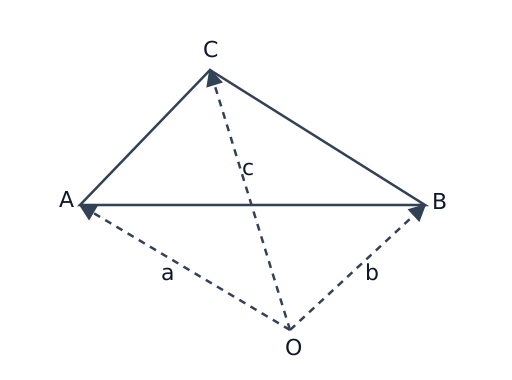
Triangle ABC with A lower left, B lower right and C above. A separate origin O lies below; dashed arrows from O to A, B and C label position vectors a,b,c. Triangle sides AB and AC share A. The schematic retains the Teacher-added origin and arrows without imposing coordinates.

Common mistakes

Do not substitute the scalar 0 for a×a inside a vector sum. Add the three vectors before taking their magnitude.

Solution notes

The Student leaves the anti-commutativity/zero-vector line blank; the Teacher fills it. Both print the remaining proof. The formula is independent of the choice of origin and also gives zero for a degenerate triangle.