Porisma

Worked solution

Build a parametric plane from lines or points

Find the vector equation of each plane in parametric form. All parameters in the given lines are real.

(i) The plane contains both lines

l1:r=(1,2,3)+λ(1,2,1),l2:r=(1,2,3)+μ(1,3,4).\begin{aligned}l_1:\quad\mathbf r&=(1,2,3)+\lambda(1,2,1),\\l_2:\quad\mathbf r&=(1,2,3)+\mu(1,3,4).\end{aligned}

(ii) The plane contains the point (1,2,4)(1,2,4) and the line

r=(1,2,1)+γ(1,−1,2).\mathbf r=(1,2,1)+\gamma(1,-1,2).

(iii) The plane contains A(3,1,2)A(3,1,2), B(2,1,2)B(2,1,2) and C(1,2,1)C(1,2,1).

CJC · Lecture · Example 28

(i) Use the common point and both directions

Answer

r=(1,2,3)+s(1,2,1)+t(1,3,4)\mathbf r=(1,2,3)+s(1,2,1)+t(1,3,4), s,t∈Rs,t\in\mathbb R.

The lines meet at (1,2,3)(1,2,3) and have nonparallel directions (1,2,1)(1,2,1) and (1,3,4)(1,3,4). One point and two independent in-plane directions define the plane. Setting t=0t=0 recovers l1l_1; setting s=0s=0 recovers l2l_2.

To check an additional point, use the teacher’s example:

(1,2,3)+(1,2,1)+2(1,3,4)=(4,10,12).\begin{aligned}(1,2,3)+(1,2,1)+2(1,3,4)&=(4,10,12).\end{aligned}

Thus (4,10,12)(4,10,12) lies on the plane (parameters s=1,t=2s=1,t=2). This check is integrated into the construction; it is additional teacher guidance, not a fourth printed ask.

How did this part go?

(ii) Join the given point to a point on the line

Answer

r=(1,2,4)+s(0,0,1)+t(1,−1,2)\mathbf r=(1,2,4)+s(0,0,1)+t(1,-1,2), s,t∈Rs,t\in\mathbb R.

Choose P=(1,2,4)P=(1,2,4) and the line point Q=(1,2,1)Q=(1,2,1). The displacement P−Q=(0,0,3)=3(0,0,1)P-Q=(0,0,3)=3(0,0,1) supplies a second direction independent of (1,−1,2)(1,-1,2). Its nonzero scalar multiple (0,0,1)(0,0,1) spans the same direction.

Use PP as the base point, as in the teacher solution. Taking s=−3s=-3 gives Q+t(1,−1,2)Q+t(1,-1,2), so every point of the supplied line is included. A point already on the line would not supply an independent second direction; here PP is off the line.

How did this part go?

(iii) Form two displacements from A

Answer

r=(3,1,2)+s(−1,0,0)+t(−2,1,−1)\mathbf r=(3,1,2)+s(-1,0,0)+t(-2,1,-1), s,t∈Rs,t\in\mathbb R.

Subtract position vectors:

AB→=(2,1,2)−(3,1,2)=(−1,0,0),AC→=(1,2,1)−(3,1,2)=(−2,1,−1).\begin{aligned}\overrightarrow{AB}&=(2,1,2)-(3,1,2)=(-1,0,0),\\\overrightarrow{AC}&=(1,2,1)-(3,1,2)=(-2,1,-1).\end{aligned}

These displacements are nonparallel, so the three points are non-collinear. Use A as the base point. Parameters (s,t)=(0,0),(1,0),(0,1)(s,t)=(0,0),(1,0),(0,1) recover A, B and C. Other base points or independent spanning pairs give equivalent plane equations.

How did this part go?

Compare your sketch

Expand diagram

Use the scrollbars or arrow keys to inspect details.
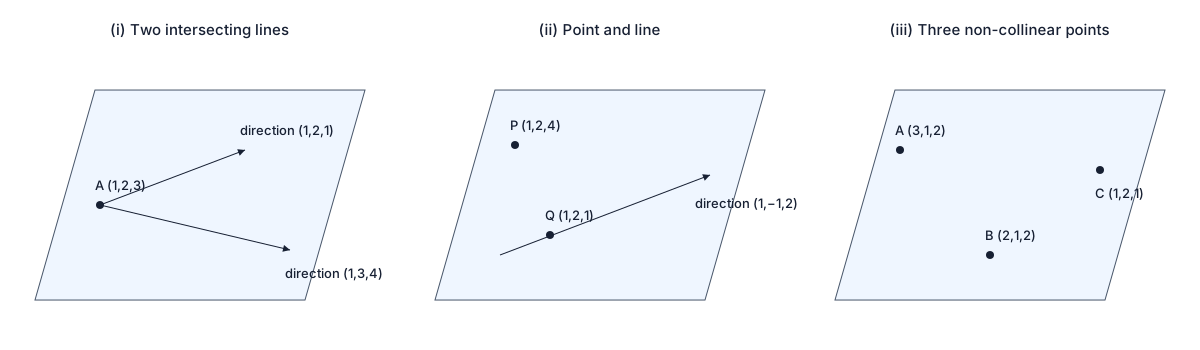
Three schematic plane patches preserve the source constructions. (i) Lines through (1,2,3) with directions (1,2,1) and (1,3,4). (ii) Point P=(1,2,4), separate from the line through Q=(1,2,1) with direction (1,−1,2). (iii) Non-collinear A=(3,1,2), B=(2,1,2), C=(1,2,1). Patches and screen positions are illustrative, not boundaries or additional numerical coordinates.

Solution notes

All three printed asks, line/point coordinates, teacher working and the extra teacher membership check are retained. Tuple notation represents the source column vectors. No printed marks or exam reference.