Porisma

Worked solution

Use a point and a normal to write a plane

Find the vector equation, in scalar product form, of the plane containing the point with position vector 3i+j+2k3\mathbf i+\mathbf j+2\mathbf k and normal to i+2j+k\mathbf i+2\mathbf j+\mathbf k.

CJC · Lecture · Example 29

Answer

r⋅(1,2,1)=7\mathbf r\cdot(1,2,1)=7.

Compare your reasoning

Use the given point a=(3,1,2)\mathbf a=(3,1,2) and nonzero normal n=(1,2,1)\mathbf n=(1,2,1):

r⋅n=a⋅n,a⋅n=3(1)+1(2)+2(1)=7.\begin{aligned}\mathbf r\cdot\mathbf n&=\mathbf a\cdot\mathbf n,\\\mathbf a\cdot\mathbf n&=3(1)+1(2)+2(1)=7.\end{aligned}

Thus the scalar-product equation is r⋅(1,2,1)=7\mathbf r\cdot(1,2,1)=7, as printed in both copies. The same plane has Cartesian equation x+2y+z=7x+2y+z=7. The source normal arrow is perpendicular to the plane; it is not an in-plane displacement.

How did this question go?

Compare your sketch

Expand diagram

Use the scrollbars or arrow keys to inspect details.
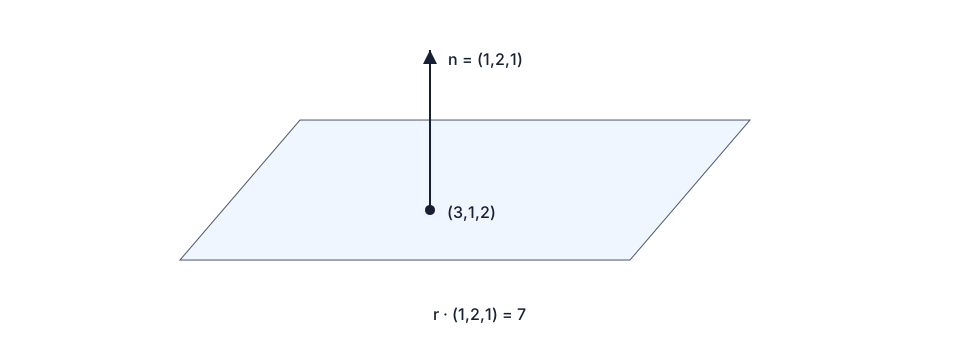
A schematic plane patch contains the given point (3,1,2). A perpendicular normal arrow is labelled n=(1,2,1). The scalar-product equation is r dot (1,2,1)=7; the drawn patch does not bound the plane.