Porisma

Worked solution

Separate a line–plane distance from a point–plane distance

Find a vector equation of the line through A(3,1,2)A(3,1,2) perpendicular to the plane r⋅(2i−j+k)=4\mathbf r\cdot(2\mathbf i-\mathbf j+\mathbf k)=4.

(i) Find the intersection of the line and plane.

(ii) State the shortest distance from the line to the plane.

(iii) Find the shortest distance from A to the plane.

CJC · Lecture · Example 37

Construct the perpendicular line

Answer

r=(3,1,2)+λ(2,−1,1)\mathbf r=(3,1,2)+\lambda(2,-1,1), λ∈R\lambda\in\mathbb R.

The plane normal (2,−1,1)(2,-1,1) supplies the direction of a perpendicular line. Use A as the base point. This construction answers the initial unnumbered ask before (i)–(iii).

How did this part go?

(i) Intersect the normal line with the plane

Answer

B=(2,32,32)B=(2,\frac32,\frac32).

A point of the line has position (3+2λ,1−λ,2+λ)(3+2\lambda,1-\lambda,2+\lambda). At its intersection B,

2(3+2λ)−(1−λ)+(2+λ)=4,6+4λ−1+λ+2+λ=4,λ=−12.\begin{aligned}2(3+2\lambda)-(1-\lambda)+(2+\lambda)&=4,\\6+4\lambda-1+\lambda+2+\lambda&=4,\\\lambda&=-\frac12.\end{aligned}

Hence B=(3−1,1+1/2,2−1/2)=(2,3/2,3/2)B=(3-1,1+1/2,2-1/2)=(2,3/2,3/2), the source point (2,1.5,1.5)(2,1.5,1.5). The line is perpendicular to the plane, so B is also A’s perpendicular foot.

How did this part go?

(ii) Use the fact that the infinite line intersects the plane

Answer

00.

B belongs to both sets. Therefore the shortest distance between the entire line and the plane is zero. This is the line–plane distance requested here; the point A itself need not be on the plane.

How did this part go?

(iii) Find A’s distance using both printed methods

Answer

62\frac{\sqrt6}{2} units.

Method 1: use the perpendicular foot B.

AB→=B−A=(−1,12,−12).\begin{aligned}&\overrightarrow{AB}\\ & =B-A\\ & =(-1,\tfrac12,-\tfrac12).\end{aligned}

Thus

h=∣AB→∣=1+14+14=62.h=|\overrightarrow{AB}|=\sqrt{1+\tfrac14+\tfrac14}=\frac{\sqrt6}{2}.

Method 2: project from a convenient point in the plane. Set C=(c,0,0)C=(c,0,0); the plane gives 2c=42c=4, so C=(2,0,0)C=(2,0,0). Then CA→=A−C=(1,1,2)\overrightarrow{CA}=A-C=(1,1,2) and the unit normal is (2,−1,1)/6(2,-1,1)/\sqrt6:

h=∣CA→⋅n^∣=∣2−1+2∣6=62.\begin{aligned}h&=\left|\overrightarrow{CA}\cdot\widehat{\mathbf n}\right|\\&=\frac{|2-1+2|}{\sqrt6}\\&=\frac{\sqrt6}{2}.\end{aligned}

Both printed methods agree. Unlike the full line in (ii), A is not in the plane: A⋅(2,−1,1)=7≠4A\cdot(2,-1,1)=7\ne4, so its distance is positive.

How did this part go?

Compare your sketch

Expand diagram

Use the scrollbars or arrow keys to inspect details.
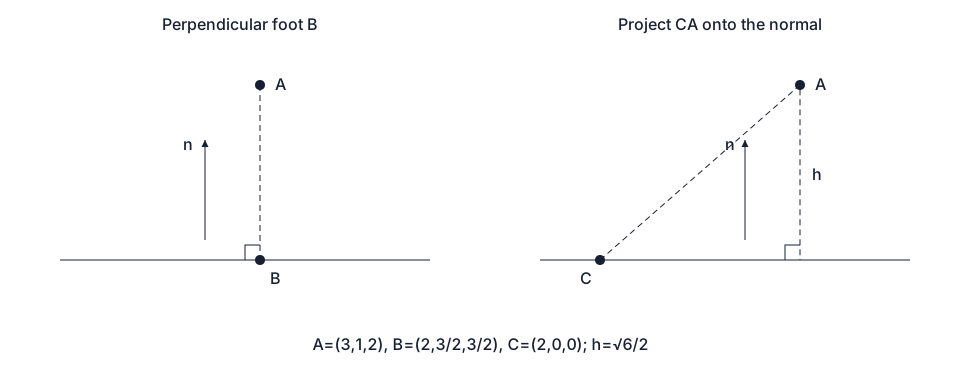
Two schematic source views. Left: A lies above its perpendicular foot B on the plane, with normal n and a right-angle marker at B. Right: C is a different point in the plane, CA is oblique and its projection onto the normal has length h. Numeric data are A=(3,1,2), B=(2,3/2,3/2), C=(2,0,0). Screen positions are schematic.

Solution notes

The initial line-construction ask and all three numbered asks are retained. Both printed distance methods and source A/B/C labels preserved. Four teaching parts separate the unnumbered task from (i)–(iii); no printed marks.