Worked solution
Separate infection counts from a later conditional-test model
During a pandemic, an unknown infectious disease spread through a population. Researchers wanted to study the probability, , that a person is infected. They collected some data from a random sample of 25 people.
(i) State, in the context of this question, two assumptions needed for the number of infected people to be well modelled by a binomial distribution. marks
Assume now that these assumptions do in fact hold.
(ii) It is given that the probability that at most 2 people are infected is 0.0982. Write an equation in and solve for . marks
A total of 30 random samples of 25 people were chosen from this population.
(iii) Find the probability that the total number of samples with at most 2 infected people is at least 5. marks
It is now given that .
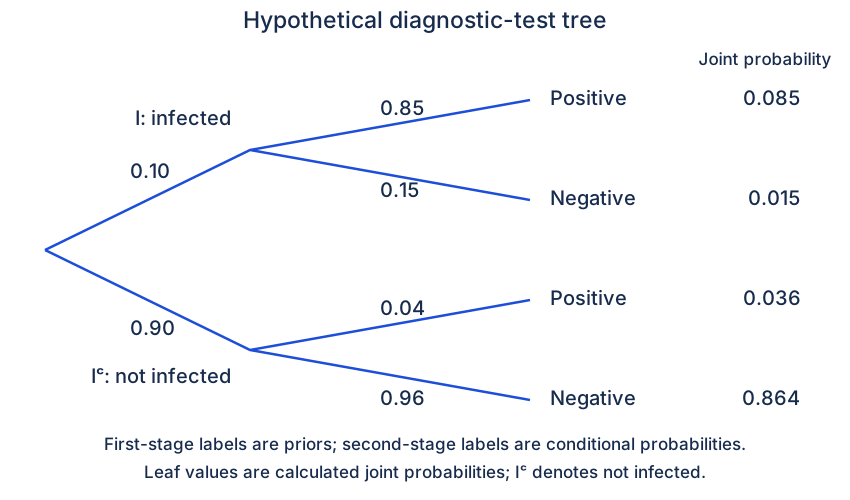
A diagnostic test for the presence of the disease was carried out on the population. It was found that the percentage of infected people who were tested positive is 85%, while the percentage of non-infected people who were tested negative is 96%.
(iv) Find the probability that a person who tested positive carries the disease. marks
(v) Hence or otherwise, find the probability that a person who tested positive does not carry the disease. mark
(vi) Discuss briefly if the diagnostic test is worthwhile. mark
[2021/SAJC/II/10]
CJC · Review Problems · Question 17
Answer
(ii) ; (iii) ; with the new , (iv) , (v) ; (vi) either source conclusion needs its supporting argument.
(i)
Assume the infection probability is the same p for every sampled person and that infection indicators for the sampled people are independent.
(ii)
Let . The equation is , equivalently . Solving gives , which is the printed (3 s.f.).
(iii)
Let count samples with at most two infected people. Under independent sample outcomes, . Then (3 s.f.). Use the given .0982, not a probability recalculated from rounded p=.200.
(iv)
The question now sets a new p=.10. Write I for infected and + for positive. The tree gives . Bayes’ rule gives (3 s.f.).
(v)
(3 s.f.). This is the fraction of positive results belonging to uninfected people in the given hypothetical model.
(vi) Source argument in favour
The source accepts a reasoned yes argument: about 70.2% of positive results identify infected people, and earlier identification could allow timely treatment or help prevent spread in the hypothetical setting.
(vi) Source alternative argument
The source also accepts a reasoned no argument: close to 30% of positive results belong to uninfected people, so responses to false positives could cause unnecessary treatment and resource use; grouping such people with infected people in quarantine could expose them to infection. These are conditional discussion arguments. The probabilities alone do not settle worthwhileness without the consequences, costs and use of the test results.
Compare your sketch
Expand diagramFit diagram to page
Use the scrollbars or arrow keys to inspect details.
Common mistakes
The infection rate solved in (ii) is replaced in the later test model; a positive test is not certain infection.
Solution notes
The tree and discussion belong to the printed hypothetical examination model; both accepted source arguments and their conditional reasoning are retained.