Porisma

Worked solution

Plot polar points and interpret a complex multiplier

The numbers z1,z2z_1,z_2 satisfy ∣z1∣=4|z_1|=4, arg⁡z1=π/3\arg z_1=\pi/3, ∣z2∣=2|z_2|=2, arg⁡z2=−π/6\arg z_2=-\pi/6.

(i) On an Argand diagram with origin OO, mark their points and deduce the exact value of ∣z1−z2∣|z_1-z_2|. marks

(ii) Write down a number aa such that z1=az2z_1=az_2. Hence or otherwise describe their geometric relationship. marks

[2023/RVHS/II/1(modified)]

CJC · Review problems · Question 14

Answer

(i) ∣z1−z2∣=25|z_1-z_2|=2\sqrt5. (ii) a=2ia=2i: rotate 90° anticlockwise about O, then enlarge by factor 2.

(i) Place the points and find the distance

Place z1z_1 at radius 4 and angle 60° in quadrant I, and z2z_2 at radius 2 and angle −30° in quadrant IV. Their Cartesian forms are z1=2+23 iz_1=2+2\sqrt3\,i and z2=3−iz_2=\sqrt3-i. The angle between the rays is π/3−(−π/6)=π/2\pi/3-(-\pi/6)=\pi/2, so the triangle is right-angled at OO. Hence ∣z1−z2∣=42+22=20=25|z_1-z_2|=\sqrt{4^2+2^2}=\sqrt{20}=2\sqrt5.

How did this part go?

(ii) Describe the transformation about O

The multiplier has modulus 4/2=24/2=2 and argument π/3−(−π/6)=π/2\pi/3-(-\pi/6)=\pi/2, so a=2ia=2i. Starting from the point for z2z_2, rotate 90° anticlockwise about OO, then enlarge by scale factor 2 about OO to reach the point for z1z_1. Indeed 2i(3−i)=2+23 i2i(\sqrt3-i)=2+2\sqrt3\,i.

How did this part go?

Compare your sketch

Expand diagram

Use the scrollbars or arrow keys to inspect details.
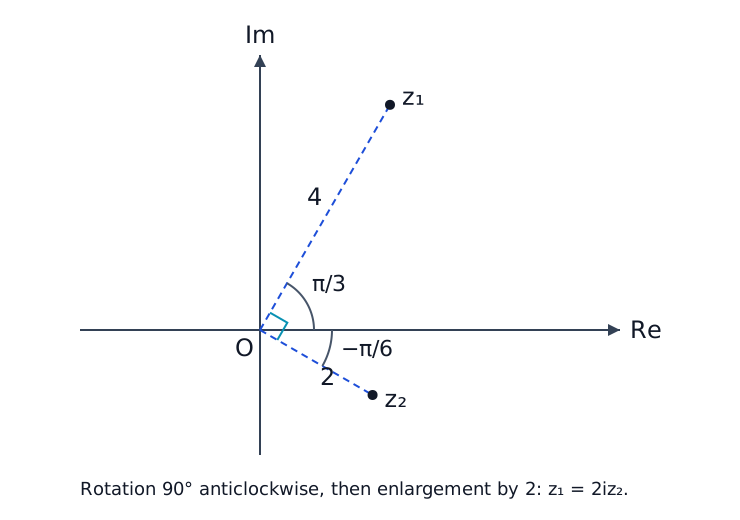
Argand diagram: z₁ has radius 4 and argument π/3 in quadrant I; z₂ has radius 2 and argument −π/6 in quadrant IV. Dashed rays from O have lengths 4 and 2 and meet at a right angle. The positive Re and Im axes, O, z₁, z₂ and both directed angles are labelled. The distance between the points is 2√5.

Common mistakes

|z₁−z₂| is a distance, not the difference of the two moduli. The enlargement and rotation are about O.

Solution notes

Source filename says 2026; printed header says 2025/JC2. Both identities are retained; rendered pages determine radicals and modulus bars.

Read the hint