Worked solution
Compare two slice directions and translate an axis of rotation
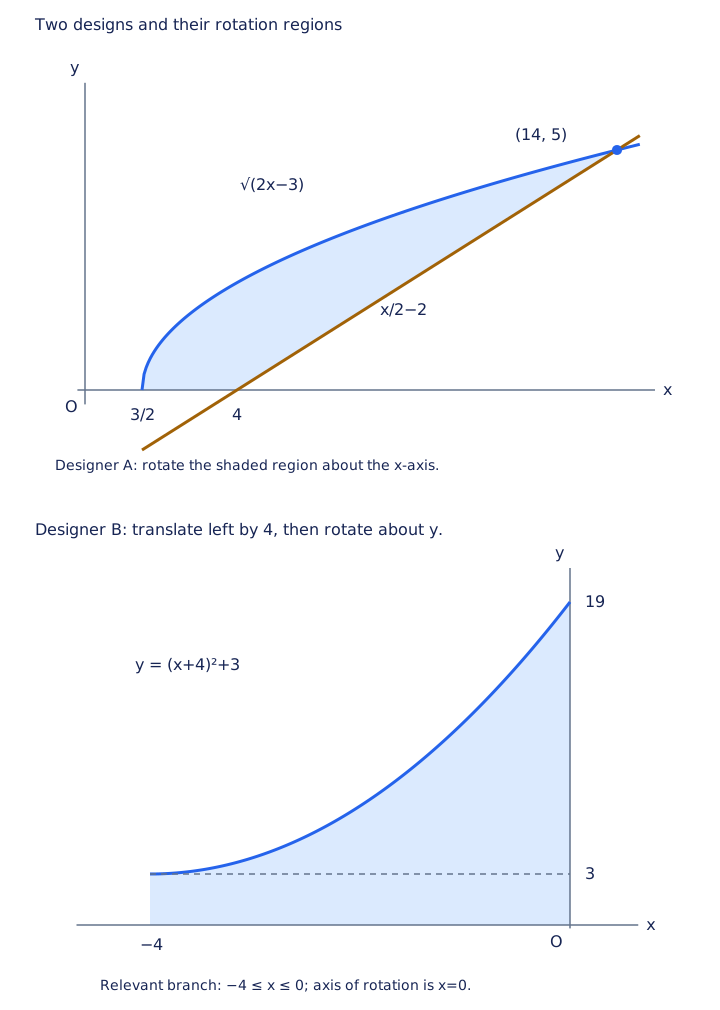
Designer A programs a machine to cut a thin material into the region enclosed by , and the x-axis.
(i) Sketch suitable graphs and find its exact surface area. marks
(ii) Rotate that region through four right angles about the x-axis to form a closed object. Find its volume. marks
(iii) Designer B rotates the region bounded by , and both axes through four right angles about . Write the equation of translated four units in the negative x-direction, and determine the resulting volume. marks
[2018/MI/Promo/PU2/I/11]
CJC · Review problems · Question 16
Answer
Area ; (ii) corrected cubic units; (iii) translated curve , volume .
(i) Locate the meeting point and use horizontal strips
Write the boundaries as and . Equality gives ; the square-root graph requires , so and . The x-intercepts are and . Area square units.
(i) Alternative: subtract two vertical areas
The same area is .
(ii) Method 1: subtract the inner washers
, or cubic units (3 s.f.). The source prints the same integral setup but reports ; that numerical evaluation is incorrect.
(ii) Method 2: subtract a cone
The full outer solid has volume . The removed cone has radius and height , so its volume is . Their difference is again , confirming the corrected result independently of numerical quadrature.
(iii) Translate the curve and preserve the relevant branch
After shifting the original x-coordinate left by , the curve is , with the region now on and rotation axis . Its right-side inverse branch is for .
(iii) Add the base cylinder and variable-radius disks
The source setup is . Evaluation gives cubic units (3 s.f.). Shells in the original coordinates, , verify the same result. The radius above is ; squaring the negative translated coordinate gives its square.
Compare your sketch
Expand diagramFit diagram to page
Use the scrollbars or arrow keys to inspect details.
Common mistakes
The printed 222 contradicts both source volume methods; their actual value is 875 pi / 12, about 229.