Porisma

Worked solution

Compare work along a curved and straight path

A force field is F=M(x,y)i+N(x,y)j\mathbf F=M(x,y)\mathbf i+N(x,y)\mathbf j. For a path y=f(x)y=f(x) from x=ax=a to x=bx=b, the work is

W=∫ab[M(x,y)+N(x,y)dydx]dx.W=\int_a^b\left[M(x,y)+N(x,y)\frac{dy}{dx}\right]dx.

A field is conservative if the work from one point to another is independent of the path.

(i) Sketch C:y2=4(1−x)C:y^2=4(1-x), x≤1x\le1. marks

(ii) Find dy/dxdy/dx in terms of yy. mark

(iii) Points P,QP,Q on CC have x=1,−3x=1,-3 respectively, with QQ below the x-axis. Find line PQPQ. marks

For the remaining parts, F=x2i+xy2j\mathbf F=x^2\mathbf i+xy^2\mathbf j.

(iv) Show that work along CC from QQ to PP is ∫−31[x2+4x(1−x)1/2]dx\int_{-3}^1[x^2+4x(1-x)^{1/2}]dx, then evaluate it exactly. marks

(v) Find the work along line PQPQ from QQ to PP to 2 decimal places. marks

(vi) Determine whether F\mathbf F is conservative, with a reason. mark

[2019/NYJC/I/12]

CJC · Review problems · Question 17

Answer

PQ:y=x−1PQ:y=x-1; WC=−308/15W_C=-308/15, WL=−33.33W_L=-33.33; field not conservative.

(i) Sketch both branches and identify the selected lower arc

The parabola opens left with vertex P=(1,0)P=(1,0), y-intercepts (0,±2)(0,\pm2) and lower-branch point Q=(−3,−4)Q=(-3,-4). The path from QQ to PP uses only y=−21−xy=-2\sqrt{1-x}, not the upper branch.

How did this part go?

(ii) Differentiate implicitly

2y(dy/dx)=−42y(dy/dx)=-4, so dy/dx=−2/ydy/dx=-2/y for y≠0y\ne0. At PP the curve has a vertical tangent; the displayed slope expression is not finite there.

How did this part go?

(iii) Join the two specified points

The slope from Q=(−3,−4)Q=(-3,-4) to P=(1,0)P=(1,0) is 11, so PQPQ is y=x−1y=x-1.

How did this part go?

(iv) Substitute the lower arc into the work integrand

M+Ny′=x2+xy2(−2/y)=x2−2xy=x2+4x1−xM+Ny^{\prime}=x^2+xy^2(-2/y)=x^2-2xy=x^2+4x\sqrt{1-x}. Although the slope diverges at PP, this combined work integrand extends continuously to x=1x=1.

How did this part go?

(iv) Method 1: integrate the radical term by parts

WC=[x3/3]−31−[(8/3)x(1−x)3/2]−31+(8/3)∫−31(1−x)3/2dx=28/3−64+512/15=−308/15W_C=[x^3/3]_{-3}^1-[(8/3)x(1-x)^{3/2}]_{-3}^1+(8/3)\int_{-3}^1(1-x)^{3/2}dx=28/3-64+512/15=-308/15.

How did this part go?

(iv) Method 2: rewrite x=1−(1−x)

x2+4x1−x=x2−4(1−x)3/2+4(1−x)1/2x^2+4x\sqrt{1-x}=x^2-4(1-x)^{3/2}+4(1-x)^{1/2}. Its antiderivative is x3/3+(8/5)(1−x)5/2−(8/3)(1−x)3/2x^3/3+(8/5)(1-x)^{5/2}-(8/3)(1-x)^{3/2}. The definite value is 28/3−256/5+64/3=−308/1528/3-256/5+64/3=-308/15.

How did this part go?

(v) Evaluate the straight-path work

On y=x−1y=x-1, y′=1y^{\prime}=1. Thus WL=∫−31[x2+x(x−1)2]dx=∫−31(x3−x2+x)dx=[x4/4−x3/3+x2/2]−31=−100/3≈−33.33W_L=\int_{-3}^1[x^2+x(x-1)^2]dx=\int_{-3}^1(x^3-x^2+x)dx=[x^4/4-x^3/3+x^2/2]_{-3}^1=-100/3\approx-33.33.

How did this part go?

(vi) Compare the same endpoints and direction

WC=−308/15W_C=-308/15 and WL=−100/3W_L=-100/3 differ for the same directed endpoints Q→PQ\to P. Work depends on the path, so the field is not conservative. Negative work is permitted; it is not a geometric area to be made positive.

How did this part go?

Compare your sketch

Expand diagram

Use the scrollbars or arrow keys to inspect details.
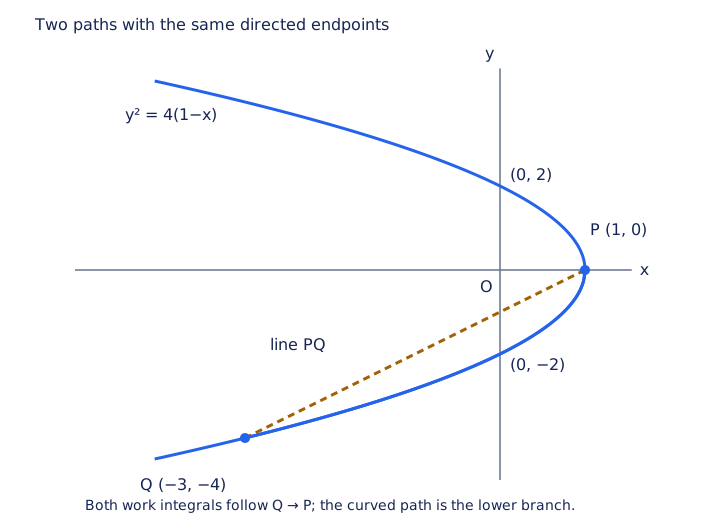
Left-opening parabola y²=4(1−x) has vertex P=(1,0), y-intercepts (0,±2) and Q=(−3,−4) on its lower branch. The selected curved path and straight line y=x−1 both run from Q to P.

Common mistakes

The lower branch and direction Q to P determine the signs; work must not be replaced by unsigned area.

Read the hint