Worked solution
Select the nonnegative branch of an integrated equation
Show that the general solution of , , is , where is arbitrary. Sketch the curve passing through .
CJC · Review problems · Question 2
Answer
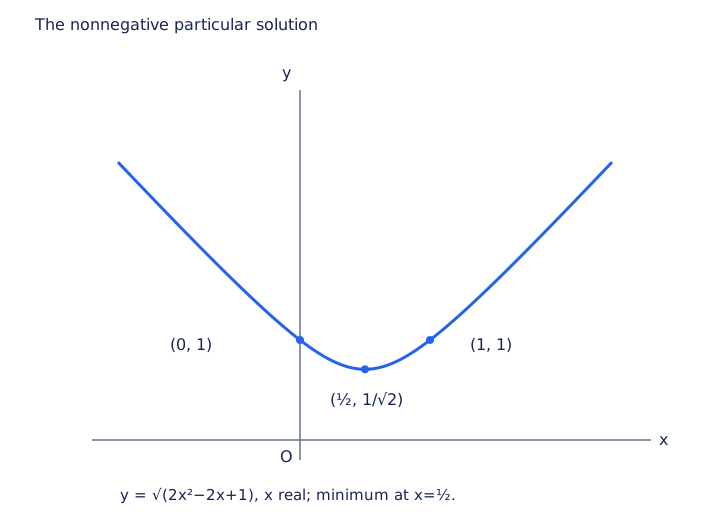
; through , with minimum .
Integrate in the dependent variable
gives . Thus , with . The nonnegative branch is chosen on intervals where it is real and differentiable; an implicit algebraic identity alone does not justify a nondifferentiable join at a zero.
Use the point and identify the minimum
At , . Since , . It is positive for every real , symmetric about , passes through and , and has minimum . The negative square-root branch is excluded. The radical is visible on the source page even though extraction drops it.
Compare your sketch
Expand diagramFit diagram to page
Use the scrollbars or arrow keys to inspect details.
Common mistakes
Squaring the solution family does not mean both square-root branches satisfy the stated nonnegative restriction.