Worked solution
Reduce order and respect a singular boundary
(i) Use to express as an equation in . marks
(ii) Solve with and at . marks
(iii) Describe the gradient as (a) mark and (b) . mark
(iv) Sketch the solution from (ii). marks
[2013/IJC/II/4(modified)]
CJC · Review problems · Question 3
Answer
; , with connected initial-value domain . Gradient limits of the formal branches are at infinity and on the left/right of .
(i) Recognise the product derivative
. The given equation rearranges to , so .
(ii) Apply the derivative condition before integrating y
, so . At , gives , hence . Integration gives ; gives .
(ii) Identify the connected initial-value domain
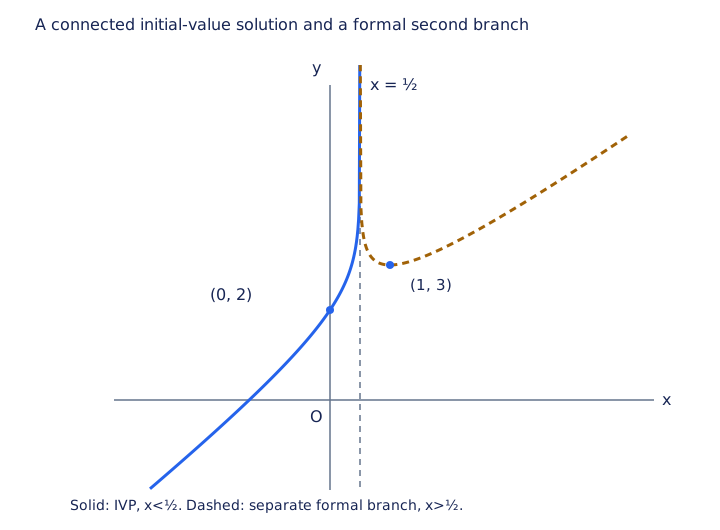
The initial point lies on . Its maximal connected solution is on . The formula with the absolute value can also be drawn for using the same constant, as the source does, but this is a separate formal branch. The divergent curve cannot be continued through , and the initial conditions do not fix an independent integration constant on the other side.
(iii) Compute the gradient limits from the correct derivative
For the displayed two-branch formula, as ; as and as . Only the negative-infinity and left-hand singular limits belong to the connected initial-value solution. A source line in (iii) prints , inserting an extra factor of two; the earlier derivation and the derivative of the stated solution give . The reported limit signs remain correct.
(iv) Sketch and distinguish the two branches
The initial-value branch passes through and increases to at the vertical asymptote . The independently displayed right branch decreases from , reaches , and then increases. The sketch uses a solid initial-value branch and a dashed formal right branch. A limiting gradient of does not establish an oblique line asymptote: the logarithmic term continues to grow in magnitude.
Compare your sketch
Expand diagramFit diagram to page
Use the scrollbars or arrow keys to inspect details.
Common mistakes
The branch on the other side of a vertical singularity is not determined by initial values at x=0.