Porisma

Worked solution

Restrict a parabola and test an inverse composite

The function ff is defined by f:x↦5−(x−2)2f:x\mapsto5-(x-2)^2, x≤4x\leq4.

(a) Sketch the graph of y=f(x)y=f(x). Hence state the range of ff. marks

(b) Explain why f−1f^{-1} does not exist. mark

The function gg is such that g:x↦f(x)g:x\mapsto f(x), x≤kx\leq k, where kk is a real constant.

(c) Given that g−1g^{-1} exists, state the largest possible value of kk. mark

Use the largest possible value of kk found in part (c) to answer the remaining parts of this question.

(d) Find g−1g^{-1} in similar form. marks

(e) The function hh is defined by h:x↦αx+1x−2h:x\mapsto\dfrac{\alpha x+1}{x-2}, x∈Rx\in\mathbb R, x≠2x\ne2 where α\alpha is a positive constant.

(i) By finding the range of hh in terms of α\alpha, determine the range of values of α\alpha such that h−1gh^{-1}g exist. marks

(ii) Solve h−1g(x)=−11h^{-1}g(x)=-11 for the case where α=6\alpha=6. marks

[2023/ASRJC/Promo/11]

CJC · Review Problems · Question 3

Answer

(a) Rf=(−∞,5]R_f=(-\infty,5]. (b) Not one-to-one. (c) k=2k=2. (d) g−1(x)=2−5−xg^{-1}(x)=2-\sqrt{5-x}, x≤5x\leq5. (e)(i) Rh=R∖{α}R_h=\mathbb R\setminus\{\alpha\} and α>5\alpha>5; (ii) x=2x=2.

(a)

Sketch the downward parabola with vertex (2,5)(2,5), vertical intercept (0,1)(0,1) and included endpoint (4,1)(4,1); retain only inputs x≤4x\leq4. It extends downwards without bound to the left, so Rf=(−∞,5]R_f=(-\infty,5].

How did this part go?

(b)

The horizontal line y=3y=3 intersects the retained graph twice, at x=2±2x=2\pm\sqrt2. Both are at most 4, so ff is not one-to-one and has no inverse function on its stated domain.

How did this part go?

(c)

The largest possible restriction boundary is k=2k=2. The branch on (−∞,2](-\infty,2] is one-to-one; any larger boundary retains points on both sides of the vertex.

How did this part go?

(d)

For y=5−(x−2)2y=5-(x-2)^2 with x≤2x\leq2, choose x=2−5−yx=2-\sqrt{5-y}. Thus g−1:x↦2−5−xg^{-1}:x\mapsto2-\sqrt{5-x}, x∈Rx\in\mathbb R, x≤5x\leq5.

How did this part go?

(e)(i)

Write h(x)=α+2α+1x−2h(x)=\alpha+\dfrac{2\alpha+1}{x-2}. Since α>0\alpha>0, the numerator 2α+12\alpha+1 is nonzero, and Rh=R∖{α}R_h=\mathbb R\setminus\{\alpha\}. The graph has asymptotes x=2x=2 and y=αy=\alpha. The composite h−1gh^{-1}g exists when Rg=(−∞,5]⊆Dh−1=RhR_g=(-\infty,5]\subseteq D_{h^{-1}}=R_h, which requires α>5\alpha>5.

How did this part go?

(e)(ii)

At α=6\alpha=6, h−1(g(x))=−11h^{-1}(g(x))=-11 implies g(x)=h(−11)=−66+1−13=5g(x)=h(-11)=\dfrac{-66+1}{-13}=5. Hence 5−(x−2)2=55-(x-2)^2=5, giving x=2x=2, which lies in the domain x≤2x\leq2.

How did this part go?

Compare your sketch

Expand diagram

Use the scrollbars or arrow keys to inspect details.
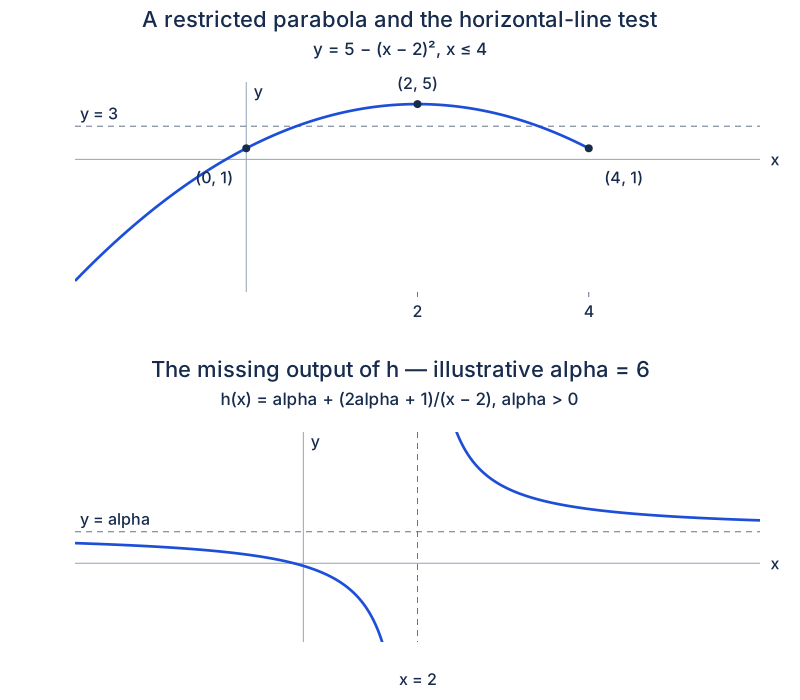
Two panels reconstruct the source graphs. The parabola y=5−(x−2)² has vertex (2,5), intercept (0,1), included endpoint (4,1), and two crossings with y=3. The rational graph has vertical asymptote x=2 and horizontal asymptote y=alpha, with left branch below alpha and right branch above it. The second panel illustrates alpha=6 while all results retain general alpha>0.

Common mistakes

The value α=5 fails because g actually attains 5; the missing output of h must lie strictly above the whole range of g.

Solution notes

The parameter graph uses α=6 solely as an illustration; the existence result is α>5.

Read the hint