Worked solution
Restrict a parabola and test an inverse composite
The function is defined by , .
(a) Sketch the graph of . Hence state the range of . marks
(b) Explain why does not exist. mark
The function is such that , , where is a real constant.
(c) Given that exists, state the largest possible value of . mark
Use the largest possible value of found in part (c) to answer the remaining parts of this question.
(d) Find in similar form. marks
(e) The function is defined by , , where is a positive constant.
(i) By finding the range of in terms of , determine the range of values of such that exist. marks
(ii) Solve for the case where . marks
[2023/ASRJC/Promo/11]
CJC · Review Problems · Question 3
Answer
(a) . (b) Not one-to-one. (c) . (d) , . (e)(i) and ; (ii) .
(a)
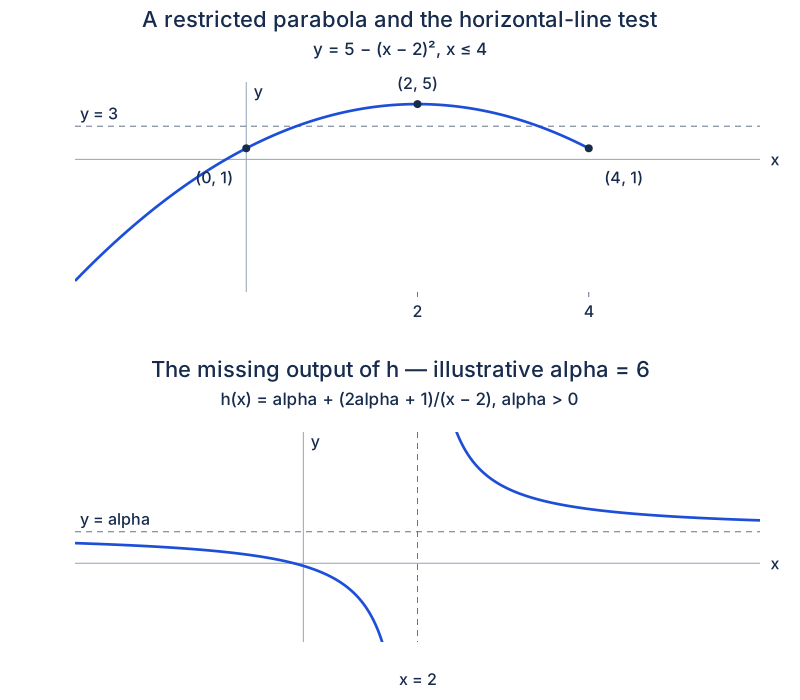
Sketch the downward parabola with vertex , vertical intercept and included endpoint ; retain only inputs . It extends downwards without bound to the left, so .
(b)
The horizontal line intersects the retained graph twice, at . Both are at most 4, so is not one-to-one and has no inverse function on its stated domain.
(c)
The largest possible restriction boundary is . The branch on is one-to-one; any larger boundary retains points on both sides of the vertex.
(d)
For with , choose . Thus , , .
(e)(i)
Write . Since , the numerator is nonzero, and . The graph has asymptotes and . The composite exists when , which requires .
(e)(ii)
At , implies . Hence , giving , which lies in the domain .
Compare your sketch
Expand diagramFit diagram to page
Use the scrollbars or arrow keys to inspect details.
Common mistakes
The value α=5 fails because g actually attains 5; the missing output of h must lie strictly above the whole range of g.
Solution notes
The parameter graph uses α=6 solely as an illustration; the existence result is α>5.