Porisma

Worked solution

Invert a restricted logarithm and carry its range into a cubic

The function ff is defined by

f:x↦ln⁡(x−a)f:x\mapsto\ln(x-a), x∈Rx\in\mathbb R, a<x≤a+2a<x\leq a+2,

where aa is a positive constant.

(i) Show that f−1f^{-1} exists. marks

(ii) Find f−1(x)f^{-1}(x) and state the domain of f−1f^{-1}. marks

(iii) Find an expression for g(x)g(x) for each of the following cases.

(a) fg(x)=xfg(x)=x, mark

(b) gf(x)=x2gf(x)=x^2. mark

(iv) The function hh is defined by

h:x↦12(x−1)(x+1)(x+5)h:x\mapsto\dfrac12(x-1)(x+1)(x+5), x∈Rx\in\mathbb R.

Find the range of hfhf. marks

[2013/HCI/I/6]

CJC · Review Problems · Question 6

Answer

f−1(x)=ex+af^{-1}(x)=e^x+a, x≤ln⁡2x\leq\ln2. (iii)(a) g(x)=ex+ag(x)=e^x+a; (b) g(x)=(ex+a)2g(x)=(e^x+a)^2 on x≤ln⁡2x\leq\ln2. (iv) (−∞,(80+567)/27]≈(−∞,8.45](-\infty,(80+56\sqrt7)/27]\approx(-\infty,8.45].

(i)

Method 1: the graph of the restricted logarithm passes every horizontal-line test, so ff is one-to-one. Method 2: f′(x)=1/(x−a)>0f\prime(x)=1/(x-a)>0 throughout (a,a+2](a,a+2], so ff is strictly increasing there and its inverse exists.

How did this part go?

(ii)

From y=ln⁡(x−a)y=\ln(x-a) obtain x=ey+ax=e^y+a. Hence f−1(x)=ex+af^{-1}(x)=e^x+a with domain Df−1=Rf=(−∞,ln⁡2]D_{f^{-1}}=R_f=(-\infty,\ln2].

How did this part go?

(iii)(a)

Since f(g(x))=xf(g(x))=x, use the inverse: g(x)=f−1(x)=ex+ag(x)=f^{-1}(x)=e^x+a. The identity holds for x≤ln⁡2x\leq\ln2, the range of ff; beyond that input the displayed formula cannot produce an allowed input of the restricted ff.

How did this part go?

(iii)(b)

Replace the input in g(f(x))=x2g(f(x))=x^2 by f−1(t)f^{-1}(t): g(t)=g(f(f−1(t)))=(f−1(t))2=(et+a)2g(t)=g(f(f^{-1}(t)))=(f^{-1}(t))^2=(e^t+a)^2 for t≤ln⁡2t\leq\ln2. The equation fixes gg on RfR_f; the printed expression is a valid extension if a larger domain is chosen.

How did this part go?

(iv) Method 1: restrict the outer graph

Track (a,a+2]→f(−∞,ln⁡2]→hRhf(a,a+2]\xrightarrow{f}(-\infty,\ln2]\xrightarrow{h}R_{hf}. Plot y=h(t)y=h(t) only for t≤ln⁡2t\leq\ln2. Its source-labelled maximum is approximately (−3.43,8.45)(-3.43,8.45) and its included endpoint is (ln⁡2,−1.48)(\ln2,-1.48), with ordinates rounded. The graph tends to −∞-\infty as t→−∞t\to-\infty, giving Rhf=(−∞,8.45]R_{hf}=(-\infty,8.45] in the source’s rounded form.

How did this part go?

(iv) Method 2: the composite graph

Plot hf(x)=12[ln⁡(x−a)−1][ln⁡(x−a)+1][ln⁡(x−a)+5]hf(x)=\frac12[\ln(x-a)-1][\ln(x-a)+1][\ln(x-a)+5] on (a,a+2](a,a+2]. It tends to −∞-\infty as x→a+x\to a^+, reaches a maximum approximately at (a+0.0324,8.45)(a+0.0324,8.45) and ends at approximately (a+2,−1.48)(a+2,-1.48). This gives the same range.

How did this part go?

Exact maximum

As an authored precision check, h′(t)=12(3t2+10t−1)h\prime(t)=\frac12(3t^2+10t-1) has the maximum at t∗=(−5−27)/3t_*=(-5-2\sqrt7)/3. Its value is M=(80+567)/27≈8.450447164M=(80+56\sqrt7)/27\approx8.450447164, attained at x=a+et∗x=a+e^{t_*}. Thus the exact range is (−∞,M](-\infty,M].

How did this part go?

Compare your sketch

Expand diagram

Use the scrollbars or arrow keys to inspect details.
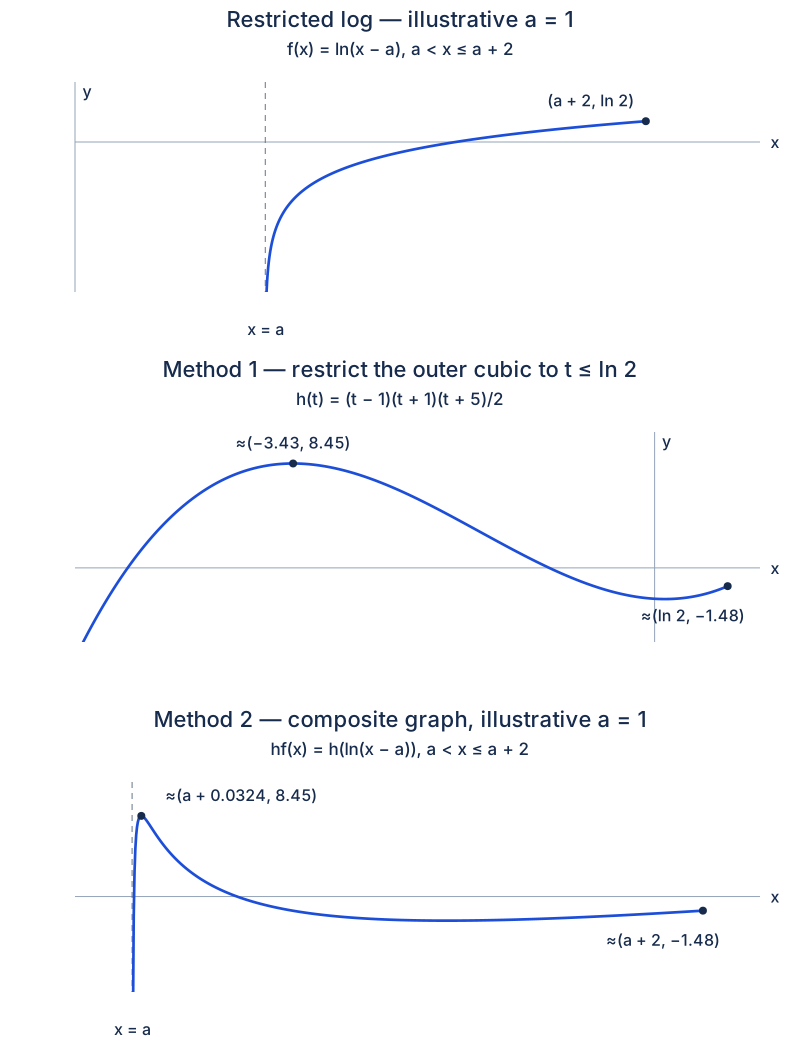
Three panels retain the restricted log graph, the outer cubic restricted to t≤ln2, and the composite graph. The log has asymptote x=a and included endpoint (a+2,ln2). The cubic has maximum near (−3.43,8.45), included endpoint near (ln2,−1.48) and no lower bound. The composite has asymptote x=a, maximum near (a+0.0324,8.45), and included endpoint near (a+2,−1.48). Drawings involving a illustrate a=1; results retain every positive a.

Common mistakes

The logarithm has a restricted domain, so its inverse and both composite identities require the corresponding range restriction.

Solution notes

The source rounds the maximum to 8.45; the exact value is supplied as an authored check. Its final range uses a square bracket before −infinity, although its mapping chain correctly uses a parenthesis. Infinity is never an included endpoint; the authored range uses a parenthesis.

The g expressions are determined on the relevant restricted identity domains. The graph parameter a=1 is illustrative, not an additional assumption.

Read the hint