Worked solution
Deduce a one-sided result from a two-sided rejection
The company Snatch provides a ride-hailing service comprising taxis and private cars in Singapore. Snatch claims that the mean waiting time for a passenger from the booking time to the time of the vehicle’s arrival is 7 minutes.
To test whether the claim is true, a random sample of 30 passengers’ waiting times is obtained. The standard deviation of the sample is 2 minutes. A hypothesis test conducted concludes that there is sufficient evidence at the 1% significance level to reject the claim.
(i) State appropriate hypotheses and the distribution of the test statistic used. marks
(ii) Find the range of values of the sample mean waiting time, . marks
(iii) A hypothesis test is conducted at the 1% significance level whether the mean waiting time of passengers is more than 7 minutes. Using the existing sample, deduce the conclusion of this test if the sample mean waiting time is more than 7 minutes. marks
[2017/DHS/II/7]
CJC · Review problems · Question 6
Answer
. Rejecting means or ; with , the right-tail 1% test also rejects.
(i) Define the variable, hypotheses and approximation
Let be a randomly chosen passenger’s waiting time in minutes and . Test against . Using the source’s divisor-n sample-variance convention, . The course large-sample approximation is under , giving
(ii) Invert the rejection region
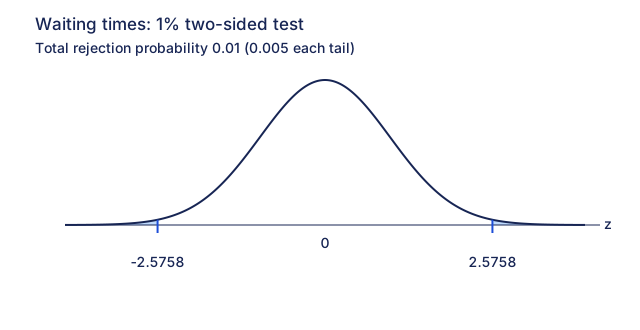
The 1% two-sided critical magnitude is . Rejection means Thus or minutes, approximately the source’s or . Waiting times are nonnegative, so the lower branch also has . Keep unrounded thresholds for boundary cases.
(iii) Use the direction of the observation
Now test . Because the observed mean is above 7, the relevant one-sided p-value is half the two-sided p-value. The given two-sided rejection implies , so . Reject : there is sufficient evidence at 1% that the mean waiting time exceeds 7 minutes.
Compare your sketch
Expand diagramFit diagram to page
Use the scrollbars or arrow keys to inspect details.
Common mistakes
A sample size of 30 supports the source’s course approximation; it is not a universal guarantee against strong skewness or dependence.
Solution notes
Source rounded thresholds 6.04/7.96 retained as approximations, not exact set boundaries. Supplied sample SD 2 is treated with the source’s n/(n−1) correction; do not repeat it if a sample SD already uses n−1.