Worked solution
Restrict a quadratic and sketch its inverse
The function f is defined as , .
(i) Explain why does not exist. mark
The function f has an inverse if its domain is restricted to .
(ii) Find the largest value of k and hence find in a similar form. marks
(iii) Sketch, on the same diagram, the graphs of , and . marks
(iv) Hence, solve the equation , leaving your answer in exact form. marks
[2013/SRJC/JC1MYE/7]
CJC · Review Problems · Question 1
Answer
(i) Not one-to-one. (ii) , for . (iii) The three open endpoints are , , ; see the sketch in the working. (iv) .
(i)
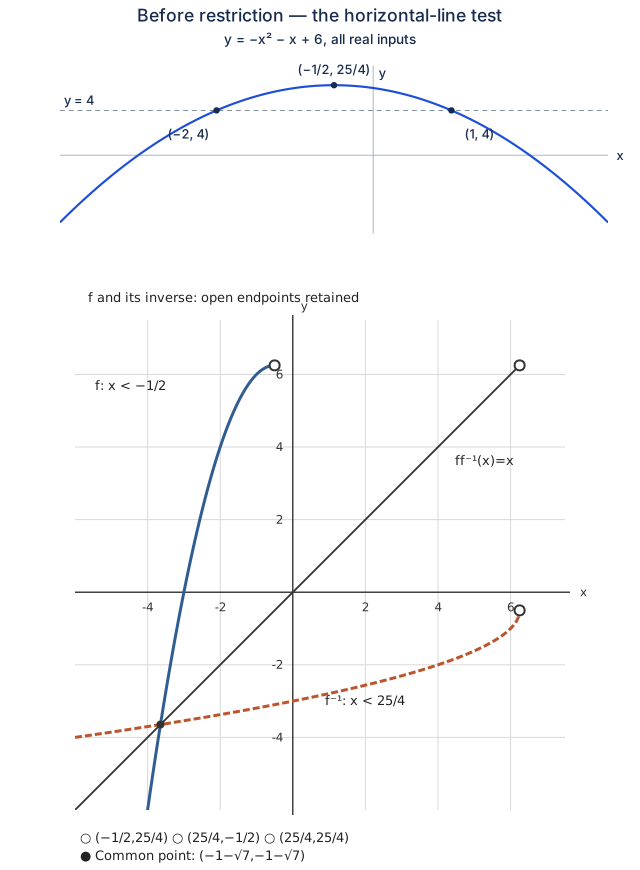
The horizontal line y=4 cuts the unrestricted graph twice. Equivalently, , so f is not one-to-one. Hence its inverse function does not exist on all of . These are the two methods printed in the key.
(ii)
Complete the square: . The vertex is at , so the largest boundary is .
From , obtain . Since , choose the minus sign.
Thus , for , . The inverse domain is .
(iii)
Sketch the restricted increasing branch of f with open endpoint . Reflect it in y=x for the inverse, whose open endpoint is . The composite is defined for , so its line has open endpoint . The sketch below retains these three open endpoints.
(iv)
On this increasing branch, a common point of f and its inverse lies on y=x. Solve
.
The restriction retains only .
Compare your sketch
Expand diagramFit diagram to page
Use the scrollbars or arrow keys to inspect details.
Common mistakes
Use the restricted f in the sketch. The open boundary of the original domain also removes the maximum output.
Solution notes
The original inverse/composite SVG is retained with a new unrestricted horizontal-line-test panel. The full two-page source comparison is recorded in evidence/review-cjc-functions-review.md.