Worked solution
Use the given variances and the central eighty percent
Oil volumes in Small, Regular and Large bottles are normal.
| Bottle | Mean (ml) | Variance (ml²) |
|---|---|---|
| Small | 610 | 25 |
| Regular | 1050 | |
| Large | 1200 | 50 |
(i) Explain why Small volume can be modelled as normal although oil volume cannot be negative. mark
(ii) Three Small bottles are randomly chosen. Find the probability that one contains more than 615 ml and the other two less than 602 ml each. marks
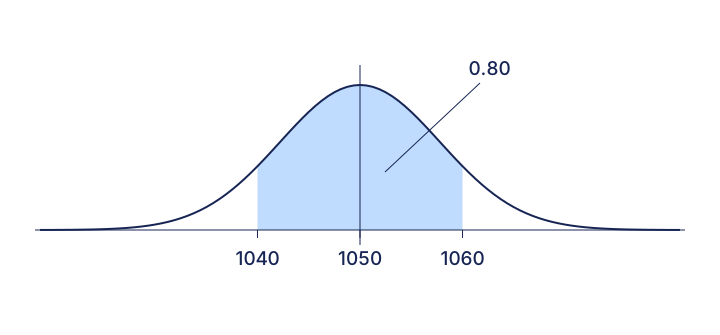
(iii) Find σ if 80% of Regular bottles contain between 1040 and 1060 ml. marks
(iv) Find the probability that two random Large bottles contain more than four times the volume in one random Small bottle. marks
The source also prints “The mass of an empty bag is assumed to be negligible”; this unrelated bag note has no role in the bottle-volume model.
[2009/TJC/II/11]
CJC · Review problems · Question 3
Answer
(i)negative tail negligible; (ii)0.00143; (iii)σ≈7.80 ml; (iv)0.0368 (3 s.f.).
Define the three volume distributions
, and in ml. Distinct selected bottles are treated as independent in the source calculations.
(i) Check the impossible negative tail
, so impossible negative volumes have negligible probability. This addresses the objection to the approximation; it does not by itself prove the actual factory distribution is normal.
(ii) Count the possible positions of the larger bottle
to 3 significant figures. The factor 3 chooses which bottle exceeds 615 ml.
(iii) Standardise the central interval boundary
Symmetry leaves 0.10 in each tail. Thus , so . Hence and σ≈7.80 ml to 3 significant figures. The source retains before final rounding.
(iv) Form the correct difference
and . Therefore and to 3 significant figures. The source distribution line prints −2 S; this is a typo, since its prompt, moments and final event all use −4 S.
Compare your sketch
Expand diagramFit diagram to page
Use the scrollbars or arrow keys to inspect details.
Common mistakes
In part (iv), the single Small volume is multiplied by 4, contributing 16 times its variance.
Solution notes
All asks/marks, full table, unrelated printed bag note, source independent-bottle model, order factor, complete quantile stages/unrounded model and every difference moment retained. Printed −2 S distribution typo qualified against −4 S working. Central 80% source sketch reconstructed accessibly.