Porisma

Worked solution

Recover a component normal distribution from a sum of two observations

X∼N(20,σ2)X\sim N(20,\sigma^2).

(i) Given P(12<X<k)=P(X>k)=0.42065P(12<X<k)=P(X>k)=0.42065, show that σ=8 to the nearest whole number, and find k. marks

X=Y1+Y2−4X=Y_1+Y_2-4, where Y1,Y2Y_1,Y_2 are independent observations of a normal variable Y. W is independent of Y and has normal mean 25 and variance 16.

(ii) Using σ=8, find E(Y)E(Y) and Var⁡(Y)\operatorname{Var}(Y), then P(W>2Y)P(W>2Y). marks

[2009/RI/II/8]

CJC · Review problems · Question 8

Answer

(i)σ≈8(nearest whole number),k≈21.6; (ii)E(Y)=12E(Y)=12, variance 32, probability 0.533 (3 s.f.).

(i) Find the remaining lower-tail area

P(X<12)=1−0.42065−0.42065=0.1587P(X<12)=1-0.42065-0.42065=0.1587. Thus P((X−20)/σ<(12−20)/σ)=P(Z<−8/σ)=0.1587P((X-20)/\sigma<(12-20)/\sigma)=P(Z<-8/\sigma)=0.1587. The source quantile gives −8/σ=−0.99982-8/\sigma=-0.99982, hence σ≈8 to the nearest whole number.

How did this part go?

(i) Find the upper-tail cutoff

Using the source rounded model X∼N(20,82)X\sim N(20,8^2), P(X>k)=0.42065P(X>k)=0.42065 implies P(X≤k)=1−0.42065P(X\le k)=1-0.42065. Therefore k≈21.6 to 3 significant figures. Using the unrounded σ from the first quantile gives the same stated rounding.

How did this part go?

(ii) Recover Y mean and variance

Let Y∼N(a,b2)Y\sim N(a,b^2). From E(X)=E(Y1+Y2−4)E(X)=E(Y_1+Y_2-4), 20=2a−420=2a-4, so a=12. From Var⁡(X)=Var⁡(Y1+Y2−4)\operatorname{Var}(X)=\operatorname{Var}(Y_1+Y_2-4), 82=2b28^2=2b^2, so b2=32b^2=32 and b=32b=\sqrt{32}. Thus E(Y)=12E(Y)=12, Var⁡(Y)=32\operatorname{Var}(Y)=32, and Y∼N(12,32)Y\sim N(12,32).

How did this part go?

(ii) Compare W with one scaled Y

W∼N(25,16)W\sim N(25,16). Then E(W−2Y)=E(W)−2E(Y)=25−2(12)=1E(W-2Y)=E(W)-2E(Y)=25-2(12)=1. Independence gives Var⁡(W−2Y)=Var⁡(W)+22Var⁡(Y)=16+4(32)=144\operatorname{Var}(W-2Y)=\operatorname{Var}(W)+2^2\operatorname{Var}(Y)=16+4(32)=144. Therefore W−2Y∼N(1,144)W-2Y\sim N(1,144) and P(W>2Y)=P(W−2Y>0)=0.533P(W>2Y)=P(W-2Y>0)=0.533 to 3 significant figures. The source prints “Var E(Y)” in this line; the intended quantity is Var(Y), as its substitution 32 confirms.

How did this part go?

Compare your sketch

Expand diagram

Use the scrollbars or arrow keys to inspect details.
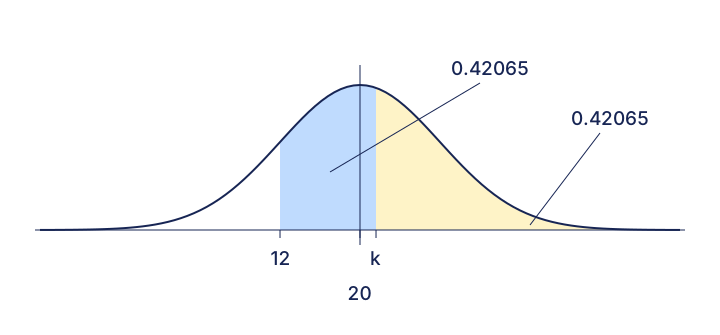
Normal curve centred at 20. Region 12<X<k has area 0.42065 and the upper tail X>k also has area 0.42065; k lies just above 20. The remaining lower tail is 0.1587.

Common mistakes

Y₁+Y₂ has twice Var(Y);2 Y has four times Var(Y). The source’s “Var E(Y)” is a typographical slip.

Solution notes

Both asks/marks, all remaining-area/quantile stages, rounding, complete component-recovery equations including√32, W difference moments and event retained. Source VarE(Y) typo qualified. Both equal-probability regions and labelled cutoffs reconstructed accessibly.

Read the hint